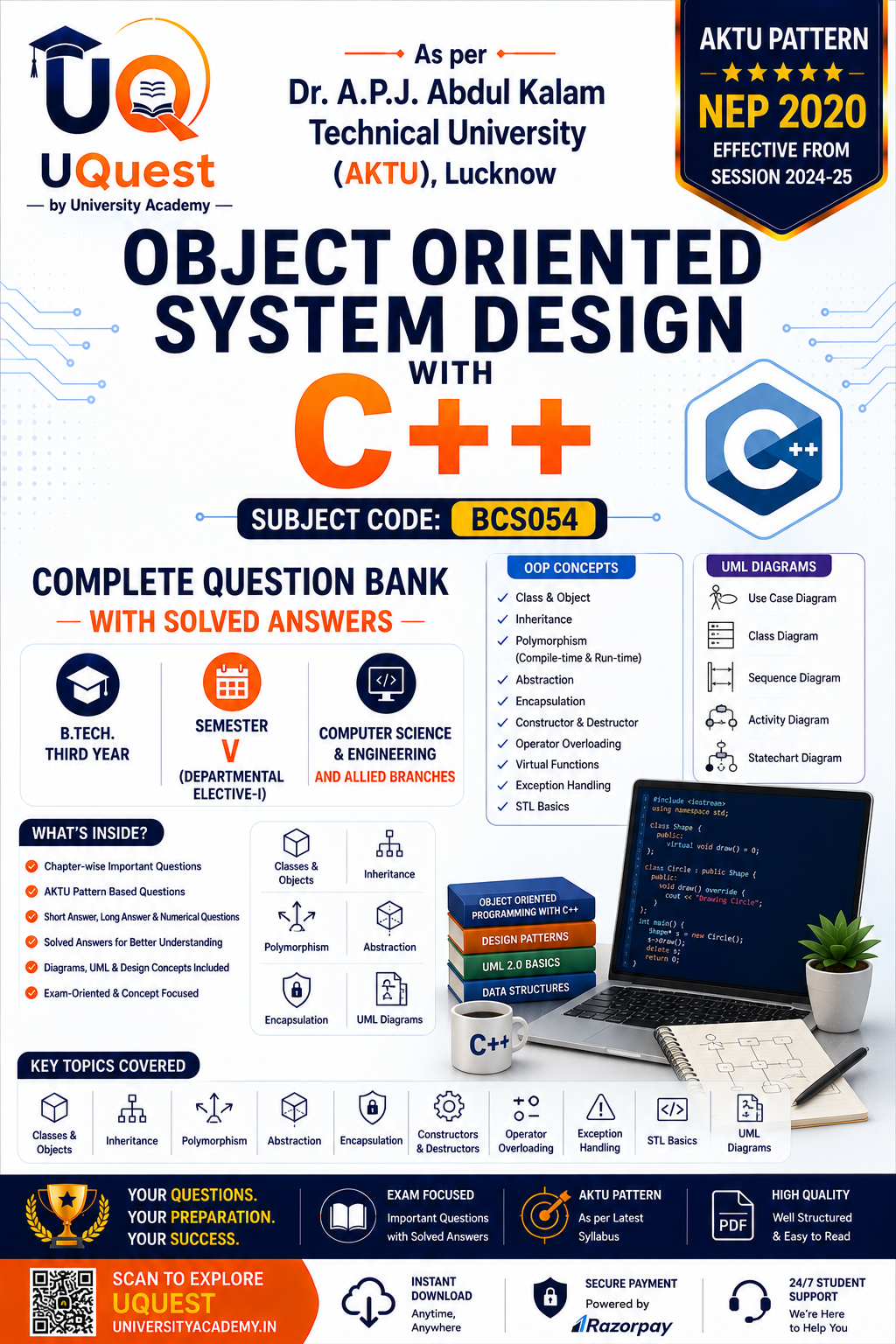
AKTU Object Oriented System Design with C++ (BCS054) Question Bank with Solutions – B.Tech 3rd Year Sem 5
BCS054
by University Academy
- English
- Semester 5
- 0 downloads
- 18 views
This question bank has been compiled by UQuest (by University Academy) to help you prepare efficiently for the BCS054 Object Oriented System Design with C++ semester examination (AKTU). Each of the five syllabus units contains 12 short-answer questions (2 marks) and 12 long-answer questions (7 or 10 marks), each with a complete, exam-ready solved answer including real, compiled-and-run worked C++ examples (constructor/destructor call order under multilevel inheritance, operator overloading for a Complex number class, function overloading combined with default arguments, static data members with a friend function, virtual functions and runtime polymorphism via a base-class pointer, and the multiple-inheritance diamond problem resolved with a virtual base class) and UML/OOP concept diagrams (the UML diagram taxonomy, class and object diagrams for a Library Management System, the five UML relationship notations, a use case diagram for an ATM system, an activity diagram for order processing, a state machine diagram for an electric bulb, sequence and collaboration diagrams for a login flow, component/deployment/package diagrams, the OOA-OOD-OOP process pipeline, procedural vs OOP comparison, the five types of C++ inheritance, the virtual function/vtable mechanism, and the constructor/destructor call-order timeline) wherever applicable.
Understanding the Tags
- MOST IMPORTANT — Covers a core syllabus concept almost certain to be examined, or closely matches a real AKTU examination question for this subject — prioritise these first.
- IMPORTANT — A high-value supporting concept commonly tested in object-oriented design and C++ courses — cover these after the Most Important questions.
PYQ: AKTU <year> (<code>) — Indicates this question (or a very close variant of it) has actually appeared in a real AKTU examination for this subject's content in the year and under the subject code shown.
A Note on Previous-Year Questions
BCS054 is a brand-new AKTU code, introduced only with the NEP2020 curriculum revision for the 2024-25 session. Real BCS054-coded examination papers are known to exist for June 2024, December 2024 and June 2025, but full verbatim question text for these specific sittings could not be reliably recovered at the time of writing — only their existence and structure could be confirmed. To give you genuinely real exam questions rather than invented ones, this book's PYQ tags instead draw on BCS054's confirmed direct predecessor code, KCS-054 "Object Oriented System Design" (the 2018-19 AKTU scheme, same title, same Departmental Elective-I slot, same five-unit UML-and-C++ syllabus), for which full verbatim papers were located for 2020-21 (mid-term), 2021-22 (end-term, dated 05-Jan-2022) and 2023-24 (mid-term). A parallel, secondary code, KOE-064 "Object Oriented Programming" (an open-elective mirror of the identical syllabus, offered to non-CS branches), supplied a small number of additional real questions from its verbatim 2021-22 paper — these are explicitly tagged "(KOE064, parallel open-elective code)" rather than presented as straight KCS054/BCS054 questions. No predecessor code could be located before the 2018 scheme revision — object-oriented system design content appears to have entered the AKTU curriculum only from 2018-19 onward, and this is disclosed honestly here as a genuine gap rather than an invented lineage. Every worked C++ example in this book was independently compiled with g++ (C++17) and actually run before being written into the book, and every program's printed output in this book is the exact, byte-for-byte verified console output of that compiled program — not a hand-predicted or approximated trace.
Suggested Preparation Strategy
- Start each unit with all questions marked ★ MOST IMPORTANT — these give the highest return on revision time.
- Type in, compile and run every worked C++ example yourself (constructor/destructor order, operator overloading, function overloading with default arguments, static members/friend functions, virtual functions, the virtual-base-class diamond fix) before checking the book's verified output — tracing program output by hand is heavily rewarded in AKTU answer sheets.
- Redraw every UML diagram (class, object, use case, activity, state machine, sequence, collaboration, component, deployment, package) from memory — diagram-based recall is heavily rewarded in AKTU answer sheets.
- Practise the CO-tagged Bloom's-level questions in increasing order of cognitive difficulty (K1/K2 short answers first, then K3/K4 analytical and code-writing long answers).
- Revise the ☆ IMPORTANT questions next, followed by the remaining questions for full syllabus coverage.
- Attempt the Model / Sample Paper at the end of this book under timed exam conditions before your semester examination.
- Computer Science and Engineering › 3rd Year
- Computer Science › 3rd Year
- Computer Engineering › 3rd Year
- Information Technology › 3rd Year
- Computer Science and Information Technology › 3rd Year
- Computer Science & Technology › 3rd Year
- Computer Science and Design › 3rd Year
- Computer Science and Engineering (Hindi) › 3rd Year
- Computer Science and Engineering (Artificial Intelligence) › 3rd Year
- Computer Science and Engineering (Artificial Intelligence & Machine Learning) › 3rd Year
- Artificial Intelligence and Machine Learning › 3rd Year
- Artificial Intelligence (AI) and Data Science › 3rd Year
- Computer Science and Engineering (Data Science) › 3rd Year
- Computer Science & Engineering (Cyber Security) › 3rd Year
- Computer Science and Engineering (Internet of Things) › 3rd Year
- Cyber Security › 3rd Year
- Data Science › 3rd Year
- Computer Science and Engineering (WP) › 3rd Year
Ratings & Reviews
Decent quality, got the job done for my prep.
Good notes overall, covers most of the syllabus.
Saved me a lot of time preparing for my exams.
Decent quality, got the job done for my prep.
Great quality, helped me score well in my semester exam.
Helpful, though a couple of topics could be more detailed.
Really helpful notes, covered everything I needed for the exam.
Clean handwriting/formatting, easy to read on mobile too.
Exactly what I was looking for — clear and concise.