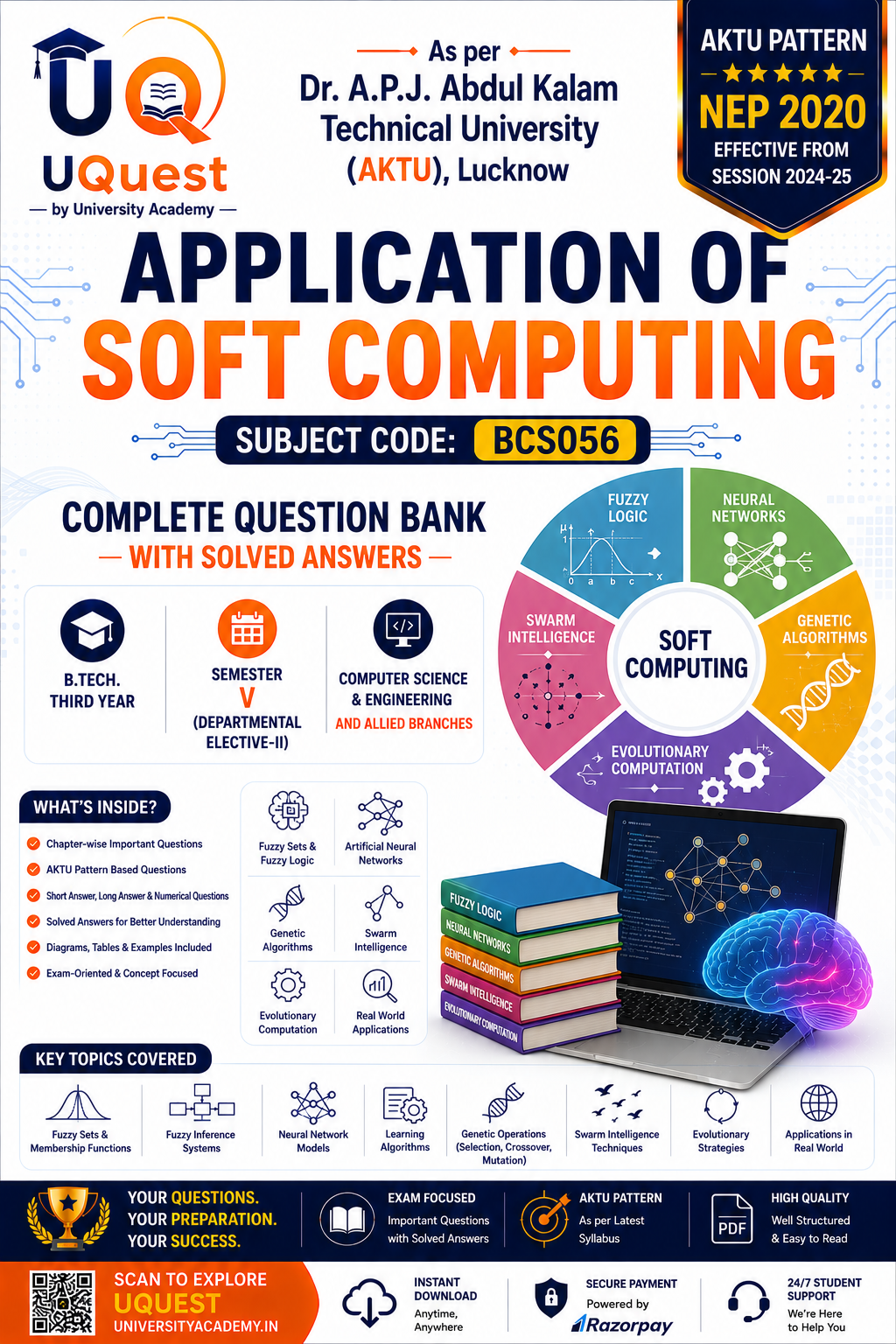
AKTU Application of Soft Computing (BCS056) Question Bank with Solutions – B.Tech 3rd Year Sem 5
BCS056
by University Academy
- English
- Semester 5
- 0 downloads
- 18 views
This question bank has been compiled by UQuest (by University Academy) to help you prepare efficiently for the BCS056 Application of Soft Computing semester examination (AKTU). Each of the five syllabus units contains 12 short-answer questions (2 marks) and 12 long-answer questions (7 marks), each with a complete, exam-ready solved answer including real, computationally verified worked examples (perceptron learning-rule training on an AND gate from zero weights, a full forward-and-backward pass of the backpropagation algorithm on a 2-2-1 network, fuzzy set union/intersection/complement with De Morgan's Law verification, centroid and mean-of-maximum defuzzification, and one complete generational cycle of a Genetic Algorithm — selection, crossover and mutation), and concept diagrams (biological neuron, McCulloch-Pitts artificial neuron model, activation functions, neural network architectures, perceptron architecture, backpropagation network flow, linear separability and XOR, crisp vs fuzzy sets, fuzzy set operations, membership functions, fuzzy inference system, fuzzy controller block diagram, GA flowchart, crossover/mutation illustration, and roulette-wheel selection) wherever applicable.
Understanding the Tags
- MOST IMPORTANT — Covers a core syllabus concept almost certain to be examined, or closely matches a real AKTU BCS056/KCS056 examination question — prioritise these first.
- IMPORTANT — A high-value supporting concept commonly tested in soft-computing courses — cover these after the Most Important questions.
PYQ: AKTU <year> (<code>) — Indicates this question (or a very close variant of it) has actually appeared in an AKTU examination for this subject under BCS056 or its direct predecessor code (KCS056) in the year shown.
Suggested Preparation Strategy
- Start each unit with all questions marked ★ MOST IMPORTANT — these give the highest return on revision time.
- Work through the perceptron-training, backpropagation, fuzzy-set, defuzzification and genetic-algorithm numericals by hand before checking the worked solution — step-by-step working is heavily rewarded in AKTU answer sheets.
- Redraw every diagram (neuron models, network architectures, fuzzy inference system, GA flowchart, roulette-wheel selection) from memory — diagram-based recall is heavily rewarded in AKTU answer sheets.
- Practise the CO-tagged Bloom's-level questions in increasing order of cognitive difficulty (K1/K2 short answers first, then K3/K4 analytical long answers).
- Revise the ☆ IMPORTANT questions next, followed by the remaining questions for full syllabus coverage.
- Attempt the Model / Sample Paper at the end of this book under timed exam conditions before your semester examination.
- Computer Science and Engineering › 3rd Year
- Computer Science › 3rd Year
- Computer Engineering › 3rd Year
- Information Technology › 3rd Year
- Computer Science and Information Technology › 3rd Year
- Computer Science & Technology › 3rd Year
- Computer Science and Design › 3rd Year
- Computer Science and Engineering (Hindi) › 3rd Year
- Computer Science and Engineering (Artificial Intelligence) › 3rd Year
- Computer Science and Engineering (Artificial Intelligence & Machine Learning) › 3rd Year
- Artificial Intelligence and Machine Learning › 3rd Year
- Artificial Intelligence (AI) and Data Science › 3rd Year
- Computer Science and Engineering (Data Science) › 3rd Year
- Computer Science & Engineering (Cyber Security) › 3rd Year
- Computer Science and Engineering (Internet of Things) › 3rd Year
- Cyber Security › 3rd Year
- Data Science › 3rd Year
- Computer Science and Engineering (WP) › 3rd Year
Ratings & Reviews
Notes
Saved me a lot of time preparing for my exams.
Great quality, helped me score well in my semester exam.
Perfect for last-minute revision before the exam.
Really helpful notes, covered everything I needed for the exam.
Useful material, would recommend to classmates.
Clean handwriting/formatting, easy to read on mobile too.
Saved me a lot of time preparing for my exams.
Very detailed explanation of every topic. Worth it.