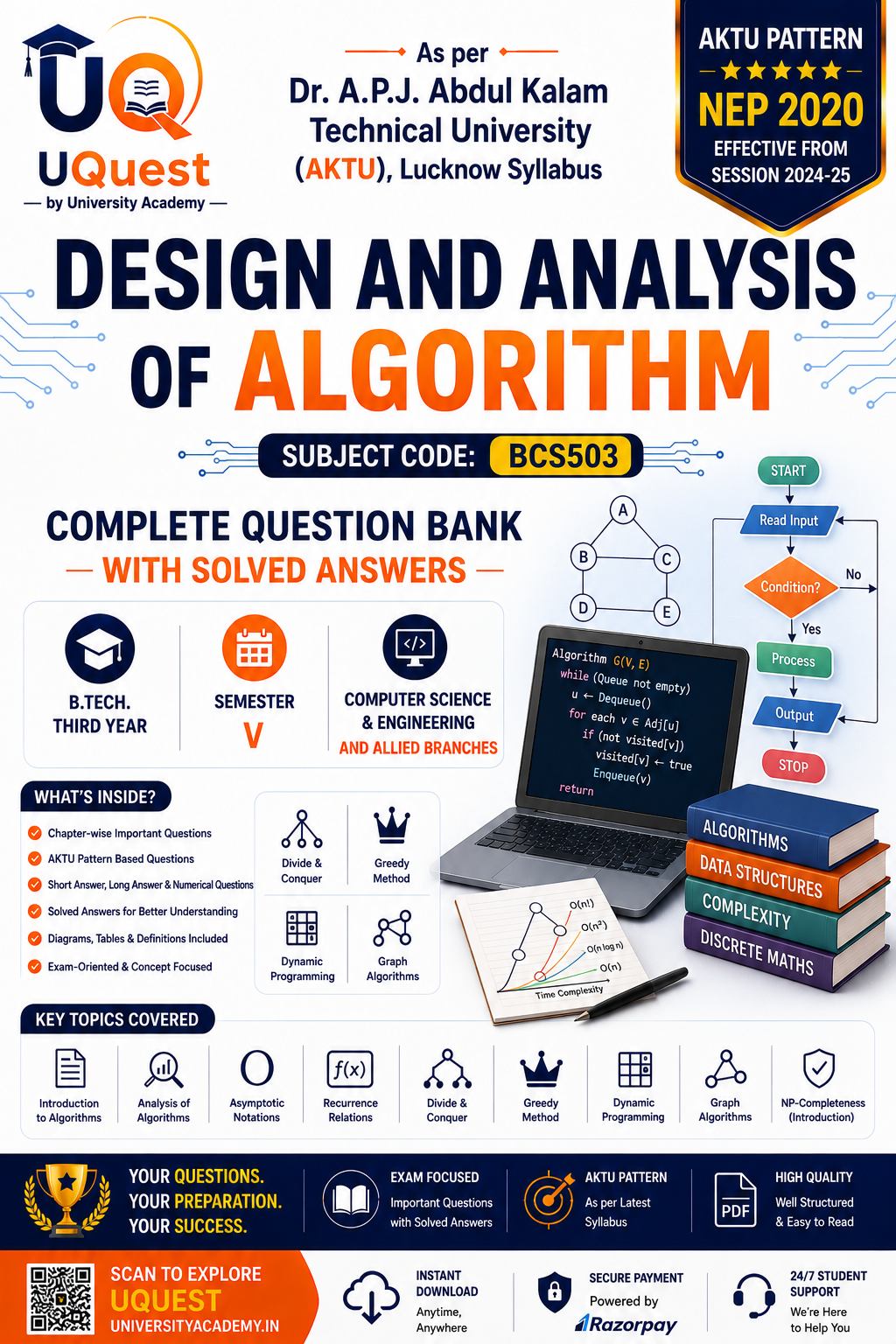
AKTU Design and Analysis of Algorithm (BCS503) Question Bank with Solutions – B.Tech 3rd Year Sem 5
BCS503
by University Academy
- English
- Semester 5
- 0 downloads
- 86 views
This question bank has been compiled by UQuest (by University Academy) to help you prepare efficiently for the BCS503 Design and Analysis of Algorithm semester examination (AKTU). Each of the five syllabus units contains 15 short-answer questions (2 marks) and 15 long-answer questions (7–10 marks), each with a complete, exam-ready solved answer including algorithm traces, recursion trees, DP tables, backtracking state-space diagrams, and fully worked numericals (sorting traces, Master theorem recurrences, Red-Black tree and Binomial Heap constructions, MST and shortest-path algorithms, knapsack DP, KMP/Rabin-Karp string matching and more) wherever applicable.
Understanding the Tags
- MOST IMPORTANT — Repeatedly asked across multiple AKTU examination years, or covers a core syllabus concept almost certain to be examined — prioritise these first.
- IMPORTANT — Asked in at least one recent AKTU examination, or a high-value supporting concept — cover these after the Most Important questions.
PYQ: AKTU <year(s)> — Indicates this question (or a very close variant of it) has actually appeared in the AKTU BCS503 / predecessor-code (NCS501/RCS502/KCS503) semester examination in the year(s) shown, compiled from official/publicly archived AKTU question papers spanning 2017–2025.
A Note on Previous-Year Questions
The PYQ year-tags in this book are compiled from publicly archived AKTU Design and Analysis of Algorithm question papers (across the code changes the subject has carried through AKTU's curriculum revisions — NCS501, RCS502, KCS503 and BCS503) covering the examinations of 2017-18, 2018-19, 2020-21, 2021-22, 2022-23, 2023-24 and 2024-25 — the most recent genuine AKTU papers for this subject publicly archived at the time of writing (two independent 2024-25 papers were located and cross-checked). No verified paper for 2019-20 (source inaccessible) or 2025-26 (examination not yet held at the time of writing) could be confirmed, so no questions are tagged with those years. Where a question in this bank closely matches a previously-asked question, the year(s) it was asked are noted; numerical questions reuse the exact figures from the original paper wherever these could be verified, and every trace/construction in this book was independently re-computed in Python before being written down, so all final answers are verified correct rather than copied. Question wording has, in places, been rephrased slightly for clarity and consistency of style — always cross-check against your own institute's latest circulars for any last-minute syllabus changes.
Suggested Preparation Strategy
- Start each unit with all questions marked ★ MOST IMPORTANT — these give the highest return on revision time.
- Attempt every algorithm trace / numerical question (sorting traces, Master theorem recurrences, RB-tree and B-Tree construction, MST, shortest-path, DP tables, backtracking) by hand at least once before checking the worked solution.
- Redraw every diagram (recursion trees, tree/heap structures, MST and shortest-path graphs, DP tables, state-space trees, the P/NP/NP-Hard/NP-Complete Venn diagram) from memory — diagram-based recall is heavily rewarded in AKTU answer sheets.
- Revise the ☆ IMPORTANT questions next, followed by the remaining questions for full syllabus coverage.
- Use the Detailed Syllabus section to confirm no topic has been missed before the exam.
- Computer Science and Engineering › 3rd Year
- Computer Science › 3rd Year
- Computer Engineering › 3rd Year
- Information Technology › 3rd Year
- Computer Science and Information Technology › 3rd Year
- Computer Science & Technology › 3rd Year
- Computer Science and Design › 3rd Year
- Computer Science and Engineering (Hindi) › 3rd Year
- Computer Science and Engineering (Artificial Intelligence) › 3rd Year
- Computer Science and Engineering (Artificial Intelligence & Machine Learning) › 3rd Year
- Artificial Intelligence and Machine Learning › 3rd Year
- Artificial Intelligence (AI) and Data Science › 3rd Year
- Computer Science and Engineering (Data Science) › 3rd Year
- Computer Science & Engineering (Cyber Security) › 3rd Year
- Computer Science and Engineering (Internet of Things) › 3rd Year
- Cyber Security › 3rd Year
- Data Science › 3rd Year
- Computer Science and Engineering (WP) › 3rd Year
Ratings & Reviews
Very Nice Notes
Very detailed explanation of every topic. Worth it.
Pretty good, minor formatting issues but content is solid.
Really helpful notes, covered everything I needed for the exam.
Decent quality, got the job done for my prep.
Clean handwriting/formatting, easy to read on mobile too.