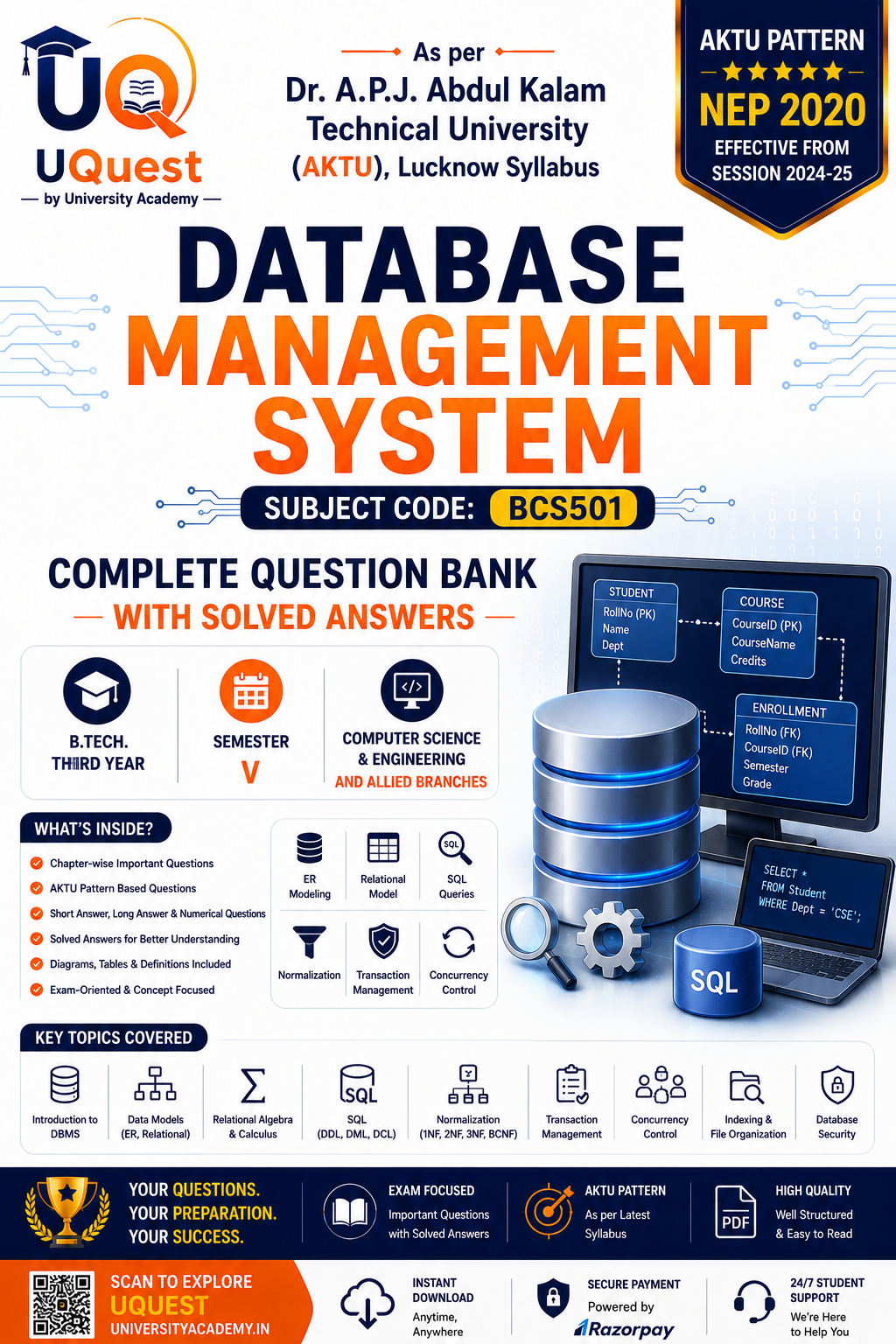
AKTU Database Management System (BCS501) Question Bank with Solutions – B.Tech 3rd Year Sem 5
BCS501
by University Academy
- English
- Semester 5
- 0 downloads
- 49 views
This question bank has been compiled by UQuest (by University Academy) to help you prepare efficiently for the BCS501 Database Management System semester examination (AKTU). Each of the five syllabus units contains 15 short-answer questions (2 marks) and 15 long-answer questions (7–10 marks), each with a complete, exam-ready solved answer including real, verified SQL queries (run and checked against an actual database), fully worked numerical examples (functional-dependency closures, minimal cover derivations, lossless-join tests, precedence-graph serializability testing), and architecture/lifecycle diagrams (DBMS three-level architecture, ER notation, normalization ladder, transaction states, locking protocols) wherever applicable.
Understanding the Tags
- MOST IMPORTANT — Repeatedly asked across multiple AKTU examination years, or covers a core syllabus concept almost certain to be examined — prioritise these first.
- IMPORTANT — Asked in at least one recent AKTU examination, or a high-value supporting concept — cover these after the Most Important questions.
PYQ: AKTU <year(s)> — Indicates this question (or a very close variant of it) has actually appeared in the AKTU BCS501 / predecessor-code (NCS-502/RCS-501/KCS-501) semester examination in the year(s) shown, compiled from official/publicly archived AKTU question papers spanning 2016–2025.
A Note on Previous-Year Questions
The PYQ year-tags in this book are compiled from publicly archived AKTU Database Management System question papers (across the code changes the subject has carried through AKTU's curriculum revisions — NCS-502, RCS-501, KCS-501 and BCS501) covering the examinations of 2016-17, 2017-18, 2018-19, 2020-21, 2021-22, 2022-23, 2023-24 and 2024-25 — the most recent genuine AKTU papers for this subject publicly archived at the time of writing. A standalone 2019-20 paper could not be independently verified (only two individual questions were confirmed via a compiled source), and no paper for 2025-26 (examination not yet held at the time of writing) could be confirmed, so full-paper tagging is not applied for those years. Where a question in this bank closely matches a previously-asked question, the year(s) it was asked are noted; every SQL query in this book was actually executed against a real database to confirm its output before being written down, and every functional-dependency closure, minimal-cover derivation, lossless-join test and serializability precedence-graph in this book was independently computed and verified in Python — so all final answers are checked correct rather than copied. Question wording has, in places, been rephrased slightly for clarity and consistency of style — always cross-check against your own institute's latest circulars for any last-minute syllabus changes.
Suggested Preparation Strategy
- Start each unit with all questions marked ★ MOST IMPORTANT — these give the highest return on revision time.
- Actually run every SQL query yourself (Oracle/MySQL/SQLite) at least once, and work through every functional-dependency/normalization/serializability problem by hand before checking the worked solution — DBMS numericals are heavily rewarded in AKTU answer sheets when shown step by step.
- Redraw every diagram (three-level architecture, ER notation, normalization ladder, transaction states, precedence graphs, locking protocols) from memory — diagram-based recall is heavily rewarded in AKTU answer sheets.
- Revise the ☆ IMPORTANT questions next, followed by the remaining questions for full syllabus coverage.
- Use the Detailed Syllabus section to confirm no topic has been missed before the exam.
- Computer Science and Engineering › 3rd Year
- Computer Science › 3rd Year
- Computer Engineering › 3rd Year
- Information Technology › 3rd Year
- Computer Science and Information Technology › 3rd Year
- Computer Science & Technology › 3rd Year
- Computer Science and Design › 3rd Year
- Computer Science and Engineering (Hindi) › 3rd Year
- Computer Science and Engineering (Artificial Intelligence) › 3rd Year
- Computer Science and Engineering (Artificial Intelligence & Machine Learning) › 3rd Year
- Artificial Intelligence and Machine Learning › 3rd Year
- Artificial Intelligence (AI) and Data Science › 3rd Year
- Computer Science and Engineering (Data Science) › 3rd Year
- Computer Science & Engineering (Cyber Security) › 3rd Year
- Computer Science and Engineering (Internet of Things) › 3rd Year
- Cyber Security › 3rd Year
- Data Science › 3rd Year
- Computer Science and Engineering (WP) › 3rd Year
Ratings & Reviews
Pretty good, minor formatting issues but content is solid.
Good notes overall, covers most of the syllabus.
Pretty good, minor formatting issues but content is solid.
Very detailed explanation of every topic. Worth it.
Helpful, though a couple of topics could be more detailed.
Decent quality, got the job done for my prep.
Decent quality, got the job done for my prep.
Nice notes, helped me understand the tricky topics.