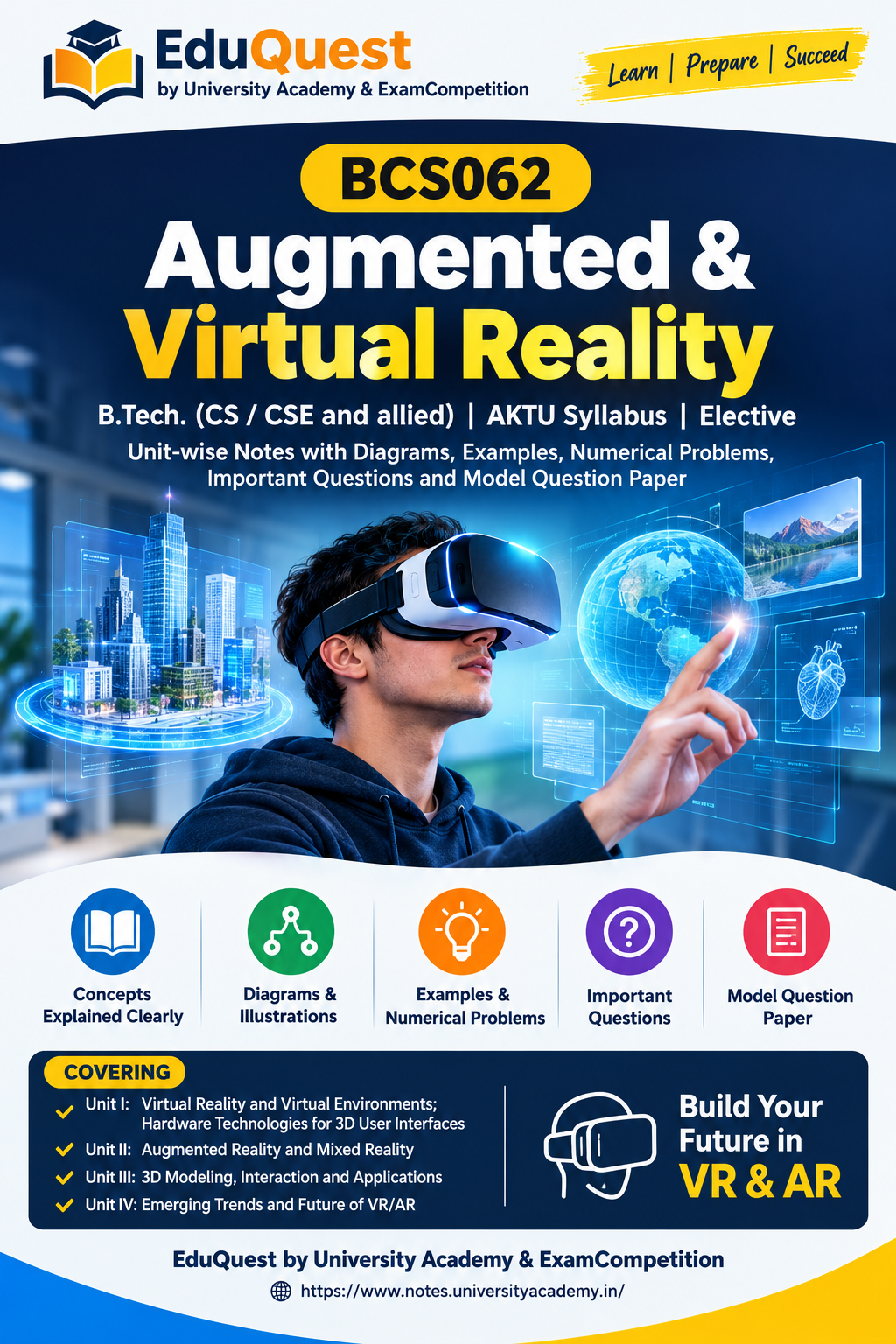
AKTU B.Tech BCS062 Augmented and Virtual Reality Notes
BCS062
by EduQuest by University Academy & ExamCompetition
- English
- 146 pages
- 0 downloads
- 5 views
Prepare for your B.Tech. examinations with these comprehensive BCS062 Augmented and Virtual Reality Notes. This 146-page study resource covers Virtual Reality (VR), Augmented Reality (AR), Mixed Reality, 3D user interfaces, VR hardware, input devices, software technologies, interaction techniques and real-world applications. The PDF includes detailed explanations, diagrams, examples, solved numerical problems, important questions, revision aids and an AKTU-format model question paper.
Subject Details
- Subject Code: BCS062
- Subject: Augmented and Virtual Reality
- Programme: B.Tech.
- Applicable Branches: Computer Science, Computer Science & Engineering and allied branches, as indicated in the notes
- Course Type: Elective
- Course Structure: L:T:P = 3:0:0
- Product Type: Complete Study Notes
- Language: English
- Pages: 146
- Format: PDF
Complete Unit-Wise Coverage
Unit I: Virtual Reality and Virtual Environments; Hardware Technologies for 3D User Interfaces
Introduction to Virtual Reality, the Three I's of VR, immersion and presence, types and components of VR systems, historical development of VR, computer graphics, real-time rendering, flight simulation, virtual environments, VR requirements and benefits. Also covers visual, auditory and haptic displays, stereoscopic vision, output-device selection, human perception, cybersickness, ergonomics and safety.
Unit II: 3D User Interface Input Hardware
Input-device characteristics and classification, desktop input devices, tracking devices, magnetic, optical and ultrasonic tracking, 3D mice, handheld controllers, special-purpose input devices, speech input, hand and body gestures, gaze and eye tracking, EMG and brain-computer interfaces. Additional topics include input-device selection, tracker calibration, coordinate systems, filtering, prediction and controller mappings.
Unit III: Software Technologies
VR system software architecture, world space and coordinate systems, virtual-world objects, geometry, position, orientation, hierarchy and bounding volumes. Covers VR databases, tessellated data, Levels of Detail (LODs), culling, occluders, lights, cameras, scripts, interaction and feedback, graphical interfaces, control panels, world authoring and playback, VR toolkits, available software, Unity, Unreal Engine and performance optimisation.
Unit IV: 3D Interaction Techniques; Designing and Developing 3D User Interfaces; VR Applications
3D manipulation tasks, manipulation techniques, 3D travel, wayfinding, system control, graphical menus, voice and gestural commands, multimodal interaction and symbolic input. Also includes 3D user-interface design strategies, design guidelines, evaluation, VR game environment workflows and applications in engineering, architecture, education, medicine, entertainment, science, training, agriculture and other fields.
Unit V: Augmented and Mixed Reality
Augmented Reality and Mixed Reality, the reality-virtuality continuum, spatial mapping, AR taxonomy, AR system components, features and functionality, differences between AR and VR, AR challenges and registration errors, display technologies, AR software, visualisation techniques, wireless displays, mobile projection, marker-less tracking, interactivity and system evaluation. Also covers AR applications in education, healthcare and industry, mobile AR applications, artificial intelligence in AR/VR and development of an AR-based educational app.
What These Notes Include
- Complete five-unit study material
- Detailed concepts and definitions
- VR, AR and Mixed Reality comparisons
- Hardware and software architecture explanations
- Diagrams, illustrations and worked examples
- Solved numerical problems across relevant units
- Case studies and practical applications
- Unity and Unreal Engine comparisons
- Important and Most Important topic classifications
- Unit-wise important questions for practice
- Quick short-answer question banks
- Glossaries, mnemonics and revision tables
- Model answer frameworks and examination tips
- Sample model question paper in AKTU format
Important Topics for Examination Preparation
- Three I's of Virtual Reality: immersion, interaction and imagination
- Visual, auditory and haptic displays
- Tracking devices and sensing technologies
- Direct human input and special-purpose input devices
- World coordinates, VR databases, LODs, cullers and occluders
- Unity and Unreal Engine for AR/VR content creation
- 3D manipulation and wayfinding techniques
- System control and 3D user-interface design
- AR versus VR and challenges with Augmented Reality
- Marker-less tracking, AR interactivity and AR applications
Course Outcomes
The notes address the stated course outcomes: understanding the basic concepts and framework of VR; analysing the principles and multidisciplinary features of VR; applying multimodal user-interaction and perception technologies; managing large-scale VR environments in real time; and understanding AR system frameworks and applying AR tools in software development.
Who Should Use These Notes?
- B.Tech. students studying BCS062 Augmented and Virtual Reality
- Computer Science and allied-branch students
- Students preparing for university examinations
- Learners revising VR hardware, software and interaction concepts
- Students studying AR applications and 3D user-interface design
Why Choose These BCS062 Notes?
This organised study resource brings together theory, technical explanations, diagrams, numerical problems, case studies, important questions and revision aids in one PDF. It supports structured learning, topic-wise revision and examination preparation for Augmented and Virtual Reality.
Original Source File
BCS062_Augmented_Virtual_Reality_Notes.pdf
Prepared By
EduQuest by University Academy & ExamCompetition
Website: www.notes.universityacademy.in
- Computer Science and Engineering › 3rd Year
- Computer Science › 3rd Year
- Computer Engineering › 3rd Year
- Information Technology › 3rd Year
- Computer Science and Information Technology › 3rd Year
- Computer Science & Technology › 3rd Year
- Computer Science and Design › 3rd Year
- Computer Science and Engineering (Hindi) › 3rd Year
- Computer Science and Engineering (Artificial Intelligence) › 3rd Year
- Computer Science and Engineering (Artificial Intelligence & Machine Learning) › 3rd Year
- Artificial Intelligence and Machine Learning › 3rd Year
- Artificial Intelligence (AI) and Data Science › 3rd Year
- Computer Science and Engineering (Data Science) › 3rd Year
- Computer Science & Engineering (Cyber Security) › 3rd Year
- Computer Science and Engineering (Internet of Things) › 3rd Year
- Cyber Security › 3rd Year
- Data Science › 3rd Year
- Computer Science and Engineering (WP) › 3rd Year
Ratings & Reviews
No reviews yet — share your experience with this item.