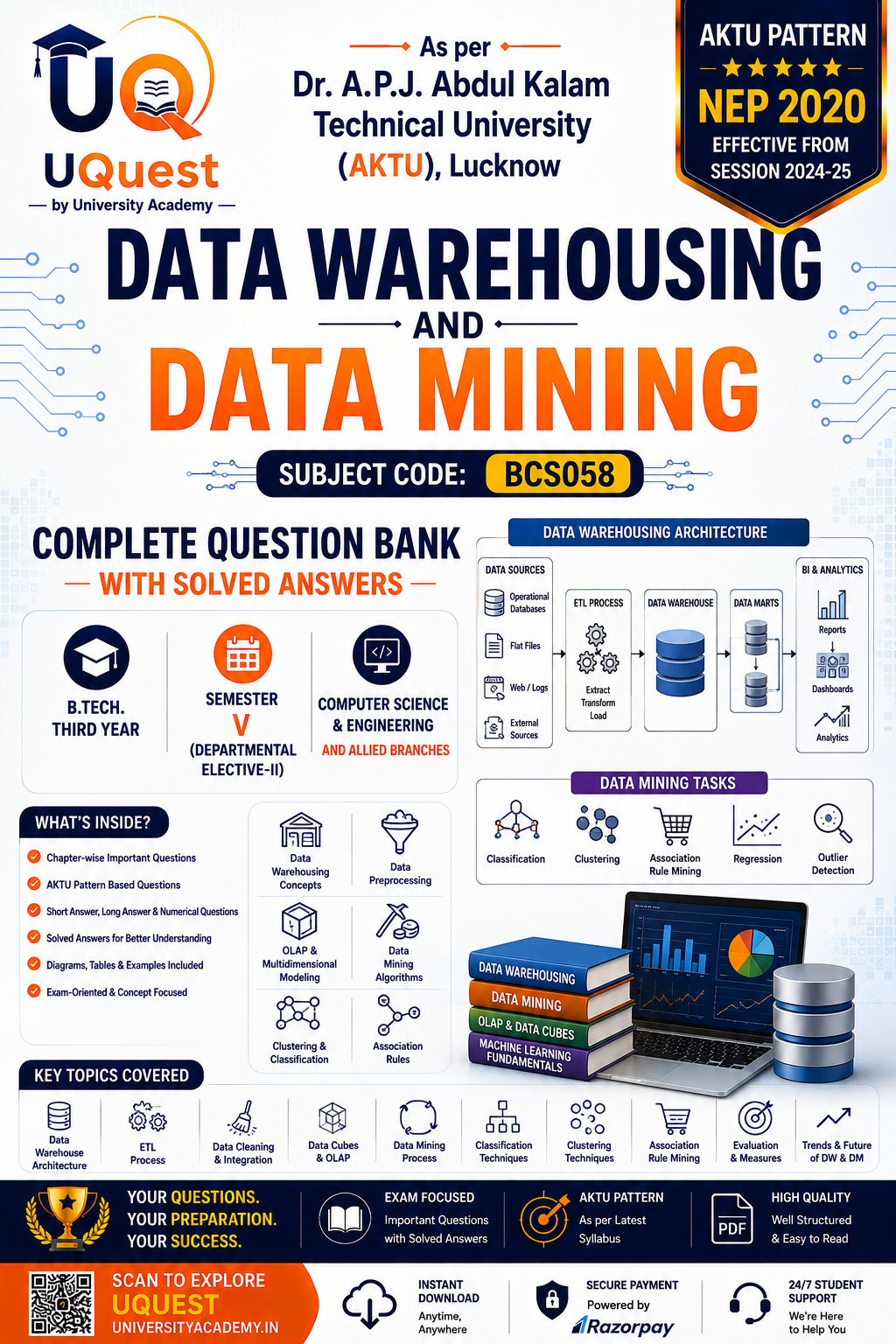
AKTU Data Warehousing and Data Mining (BCS058) Question Bank with Solutions – B.Tech 3rd Year Sem 5
BCS058
by University Academy
- English
- Semester 5
- 3 downloads
- 57 views
This question bank has been compiled by UQuest (by University Academy) to help you prepare efficiently for the BCS058 Data Warehousing and Data Mining semester examination (AKTU). Each of the five syllabus units contains 12 short-answer questions (2 marks) and 12 long-answer questions (7 marks), each with a complete, exam-ready solved answer including real, computationally verified worked examples (ID3 decision-tree induction with entropy and information-gain calculations on the classic Play-Tennis dataset, the full Apriori algorithm on the classic AllElectronics transactional database with frequent-itemset generation and strong association rules, K-Means clustering converging to two clusters, Naive Bayesian classification of a car-theft tuple, Manhattan-distance and mean/variance/standard-deviation/normalization calculations, and a multidimensional data-cube roll-up/drill-down/slice worked example), and concept diagrams (three-tier data warehouse architecture, star/snowflake/fact-constellation schemas, the multidimensional data cube, the warehouse planning lifecycle, the KDD process, the four data-preprocessing tasks, the ID3 decision tree, classification vs clustering, the clustering-methods taxonomy, the Apriori itemset lattice, OLAP operations, ROLAP/MOLAP/HOLAP server architectures, and web/spatial/temporal data-mining applications) wherever applicable.
Understanding the Tags
- MOST IMPORTANT — Covers a core syllabus concept almost certain to be examined, or closely matches a real AKTU examination question for this subject — prioritise these first.
- IMPORTANT — A high-value supporting concept commonly tested in data warehousing and data mining courses — cover these after the Most Important questions.
PYQ: AKTU <year> (<code>) — Indicates this question (or a very close variant of it) has actually appeared in a real AKTU examination for this subject's content in the year and under the subject code shown.
A Note on Previous-Year Questions
BCS058 is a brand-new AKTU code, introduced only with the NEP2020 curriculum revision for the 2024-25 session, so no verbatim BCS058-coded examination paper has yet been archived publicly at the time of writing (a real BCS058 2024-25 paper is known to exist but was not accessible in full text through any source checked). To give you genuinely real exam questions rather than invented ones, this book's PYQ tags instead draw on the SAME "Data Warehousing and Data Mining" subject content examined by AKTU under earlier and parallel codes: NCS066 (the pre-2018 CS-branch scheme, full verbatim papers located for 2017-18 and partially for 2015-16), RIT062 (the IT-branch elective, full verbatim paper located for 2018-19), and KOE093 (the cross-branch open elective carrying identical syllabus content, full verbatim paper located for 2021-22 and partially for 2023-24). Every question tagged with a real PYQ year in this book traces back to one of these five verified real papers. Genuinely no coverage could be located for the 2016-17, 2019-20, 2020-21, 2022-23 and 2025-26 AKTU sessions despite a broad search — this gap is disclosed honestly here rather than fabricating PYQ tags for those years. Every worked numerical/verified example in this book was independently computed and confirmed with runnable Python scripts before being written into the book — including three exact real-exam numericals reproduced verbatim: the Manhattan-distance tuples (22,2,45,10)/(20,10,26,2) from AKTU 2023-24 (KOE093), the animal-height mean/variance/standard-deviation dataset from AKTU 2018-19 (RIT062), and the five-point K-Means clustering problem from AKTU 2023-24 (KOE093).
Suggested Preparation Strategy
- Start each unit with all questions marked ★ MOST IMPORTANT — these give the highest return on revision time.
- Work through the ID3 decision tree, Apriori, K-Means, Naive Bayes, distance/normalization and OLAP roll-up numericals by hand before checking the worked solution — step-by-step working is heavily rewarded in AKTU answer sheets.
- Redraw every diagram (star/snowflake/fact-constellation schemas, KDD process, decision tree, clustering taxonomy, OLAP operations) from memory — diagram-based recall is heavily rewarded in AKTU answer sheets.
- Practise the CO-tagged Bloom's-level questions in increasing order of cognitive difficulty (K1/K2 short answers first, then K3/K4 analytical long answers).
- Revise the ☆ IMPORTANT questions next, followed by the remaining questions for full syllabus coverage.
- Attempt the Model / Sample Paper at the end of this book under timed exam conditions before your semester examination.
- Computer Science and Engineering › 3rd Year
- Computer Science › 3rd Year
- Computer Engineering › 3rd Year
- Information Technology › 3rd Year
- Computer Science and Information Technology › 3rd Year
- Computer Science & Technology › 3rd Year
- Computer Science and Design › 3rd Year
- Computer Science and Engineering (Hindi) › 3rd Year
- Computer Science and Engineering (Artificial Intelligence) › 3rd Year
- Computer Science and Engineering (Artificial Intelligence & Machine Learning) › 3rd Year
- Artificial Intelligence and Machine Learning › 3rd Year
- Artificial Intelligence (AI) and Data Science › 3rd Year
- Computer Science and Engineering (Data Science) › 3rd Year
- Computer Science & Engineering (Cyber Security) › 3rd Year
- Computer Science and Engineering (Internet of Things) › 3rd Year
- Cyber Security › 3rd Year
- Data Science › 3rd Year
- Computer Science and Engineering (WP) › 3rd Year
Ratings & Reviews
Helpful, though a couple of topics could be more detailed.
Well organized and easy to follow. Highly recommend!
Decent quality, got the job done for my prep.
Pretty good, minor formatting issues but content is solid.
Nice notes, helped me understand the tricky topics.
Exactly what I was looking for — clear and concise.
Nice notes, helped me understand the tricky topics.
Good notes overall, covers most of the syllabus.
Exactly what I was looking for — clear and concise.
Saved me a lot of time preparing for my exams.