PAID
AKTU Calculus and Linear Algebra (AAS103F) Notes
Calculus and Linear Algebra AAS103F
All syllabus, notes, question bank & PYQ for this subject
by University Academy
₹49.00
₹99.00
Log in to buy
- English
- 82 pages
- Semester 1
- 0 downloads
- 2 views
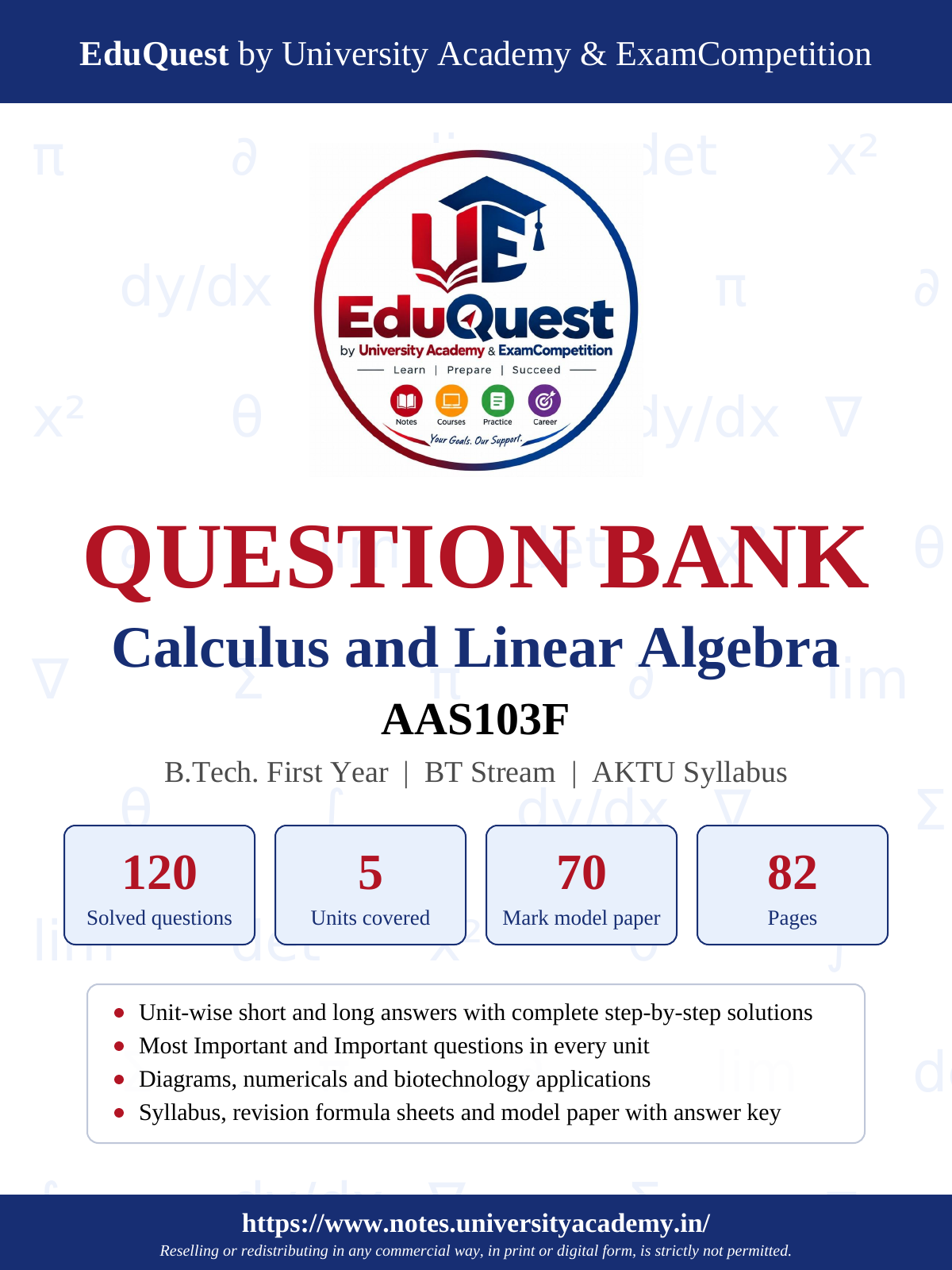
This is a unit-wise question bank for AKTU’s new course Calculus and Linear Algebra (AAS103F), written from the official syllabus. Because the course is new, there are no previous-year papers to practise from. Every question is built from the syllabus topics, so that each topic is covered in every form an examiner can ask it: definitions, derivations, proofs, numericals, applications and diagrams.
Every question has a complete, step-by-step solution in the style that earns full marks: statement or formula, working, final answer with units, and a short interpretation for applied problems.
What’s inside
- Cover, contents and “how to use” page.
- Full syllabus, with course objectives, course outcomes, unit weightage, and text and reference books.
- Syllabus coverage map, a topic-by-topic table showing which questions cover each syllabus topic, so students can find practice on any topic quickly.
Five units, each with:
- 12 short-answer questions (2 marks each) with full solutions.
- 12 long-answer questions (7 marks each) with derivations, numericals, diagrams and applications.
- Priority list of Most Important and Important questions, for last-minute revision.
- One-page revision sheet of formulas, standard results and examiner tips.
Model question paper (70 marks, 3 hours) in the end-semester pattern, with a reference map to matching practice questions and an answer key.
Diagrams and numericals throughout, including graphs of curves and areas, vector figures, and worked problems.
Syllabus covered (20% weightage per unit)
Unit 1: Differential Calculus
Functions, limit, continuity and differentiability.
Definition of derivative, its physical and geometrical significance, and derivative by first principle.
Derivative of sum, difference, product and quotient of functions.
Derivatives of polynomial and trigonometric functions, composite functions and the chain rule.
Derivatives of inverse trigonometric, implicit, exponential and logarithmic functions.
Logarithmic differentiation, parametric forms and second-order derivatives.
Applications: rate of change, maxima and minima (second derivative test).
Applications: drug delivery and pharmacokinetics, diffusion and mass transfer.
Unit 2: Integral Calculus
Integration as the inverse process of differentiation.
Integration by substitution, partial fractions and parts (simple integrals).
Basic properties and evaluation of definite integrals.
Area under simple curves, including lines, and areas of circles, parabolas and ellipses (standard form).
Applications: bioreactor engineering, cell growth and biomass estimation.
Applications: total drug exposure (AUC) and cumulative drug release.
Unit 3: Differential Equations
Definition, order and degree, general and particular solutions.
Formation of a differential equation whose general solution is given.
First-order, first-degree equations by separation of variables.
Homogeneous equations and linear equations of the type dy/dx + Py = Q.
Applications: population growth, pharmacokinetics, diffusion and bioreactor modelling.
Unit 4: Introduction to Matrices
Definition and types of matrices.
Addition, subtraction, scalar multiplication and multiplication of matrices.
Determinants: minors, cofactors and properties.
Adjoint, inverse, and solution of systems of linear equations.
Applications: bioreactor and metabolic models, diffusion and transport problems.
Unit 5: Vector Analysis
Scalar (dot) and vector (cross) products, scalar triple product and vector triple product.
Direction cosines and direction ratios.
Scalar and vector fields, gradient, divergence and curl, and directional derivatives.
Applications: biological systems, biomechanics, biomedical image and data analysis, and integration (flow).
Course outcomes
Students will be able to apply differential calculus, integral calculus, differential equations, matrix methods and vector calculus to biotechnology problems. These include drug delivery, pharmacokinetics, bioreactors, metabolic networks, diffusion and transport. All five outcomes are at the “apply” level.
Who it is for
B.Tech. first-year students of the BT stream preparing for AKTU examinations.
Students who want solved questions for every syllabus topic, not just theory.
Last-minute revision, using the priority lists and formula sheets.
Self-testing, using the model paper and its answer key.
Highlights
Covers the whole syllabus, unit-wise.
144 fully solved questions (60 short and 60 long) plus a 70-mark model paper with answer key.
Applied problems from biotechnology (pharmacokinetics, bioreactors, diffusion, biomechanics, imaging).
Clear, labelled diagrams and numericals.
Set in 1.5 line spacing with a standard gap between questions, so it is easy to read and print.
Note: Numbers in application problems are illustrative (marked “assumed”). Students should use the data given in their own question.
© EduQuest by University Academy & ExamCompetition. Reselling or redistributing this question bank in any professional or commercial way, in print or digital form, is strictly not permitted.
More study material: https://www.notes.universityacademy.in/
Ratings & Reviews
No reviews yet — share your experience with this item.