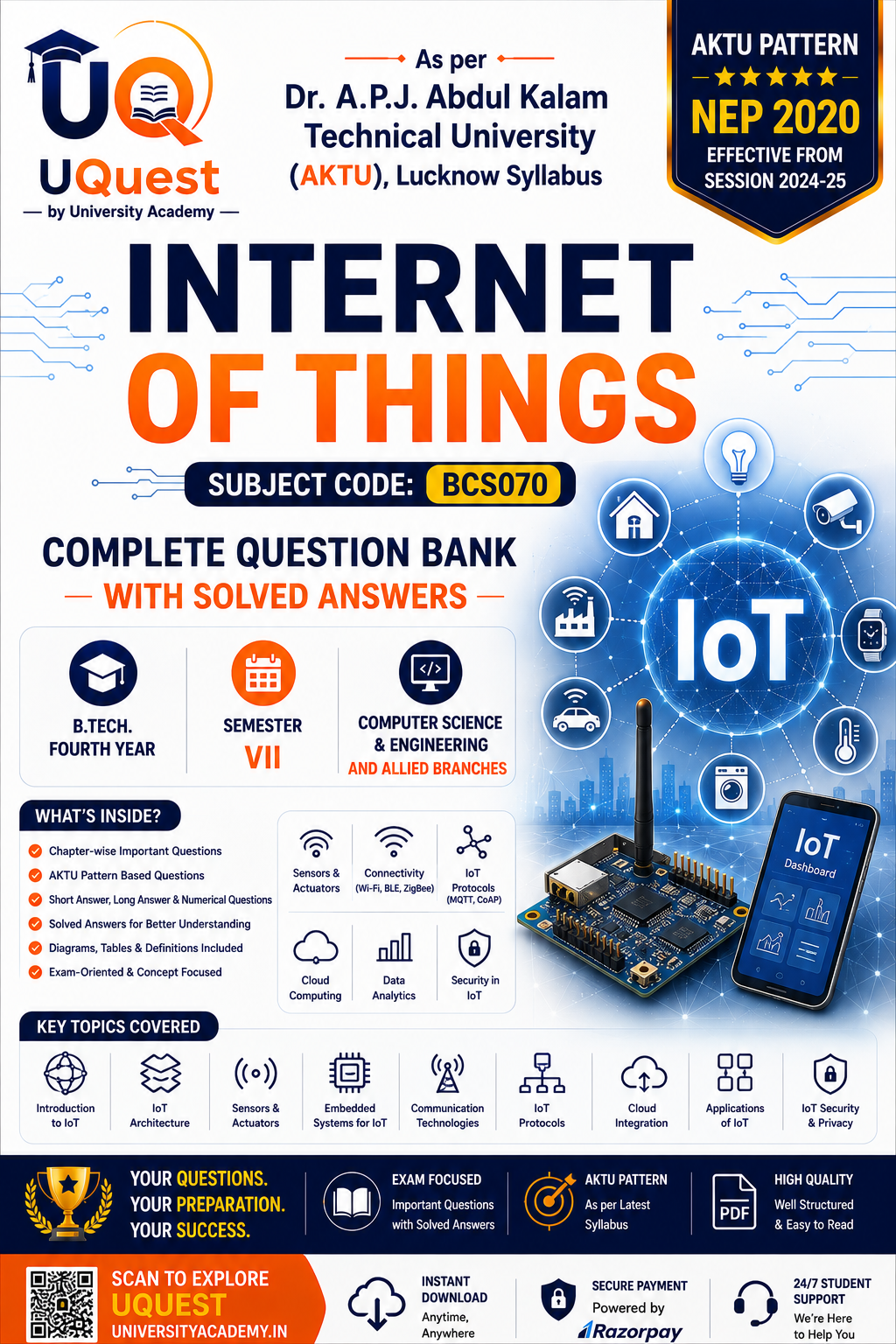
AKTU Internet of Things (BCS070) Question Bank with Solutions – B.Tech 4th Year Sem 7
BCS070
by University Academy
- English
- Semester 7
- 0 downloads
- 44 views
This question bank has been compiled by UQuest (by University Academy) to help you prepare efficiently for the BCS070 Internet of Things semester examination (AKTU). Each of the five syllabus units contains 15 short-answer questions (2 marks) and 15 long-answer questions (7–10 marks), each with a complete, exam-ready solved answer including real, verified worked examples (WSN sensor node battery lifetime under duty cycling, in-network data aggregation bandwidth/energy savings, Arduino ADC resolution & voltage-mapping, PWM duty-cycle & average voltage, smart street-light energy/cost savings, and smart-metering daily data-volume calculations), realistic Arduino C/C++ code listings, and concept diagrams (IoT conceptual framework, five-layer IoT architecture, M2M vs IoT, sensors vs actuators, RFID system, wireless sensor network architecture, embedded hardware platform comparison, MAC/routing protocol classification, data aggregation trees, Arduino board anatomy & IDE workflow, and IoT application domains) wherever applicable.
Understanding the Tags
- MOST IMPORTANT — Repeatedly asked across multiple AKTU examination years, or covers a core syllabus concept almost certain to be examined — prioritise these first.
- IMPORTANT — Asked in at least one recent AKTU examination, or a high-value supporting concept — cover these after the Most Important questions.
PYQ: AKTU <year> (<code>) — Indicates this question (or a very close variant of it) has actually appeared in an AKTU Internet of Things examination under BCS070 or a predecessor/parallel code (RCS061 or KCS-712) in the year shown, compiled from publicly archived AKTU question papers.
Suggested Preparation Strategy
- Start each unit with all questions marked ★ MOST IMPORTANT — these give the highest return on revision time.
- Work through every numerical (WSN battery lifetime, data aggregation savings, Arduino ADC resolution, PWM duty cycle, smart street-light savings, smart-metering data volume) by hand before checking the worked solution — these are heavily rewarded in AKTU answer sheets when shown step by step.
- Redraw every diagram (IoT layered architecture, M2M vs IoT, sensors/actuators, RFID, WSN architecture, embedded platforms, MAC/routing protocol classification, Arduino board anatomy) from memory — diagram-based recall is heavily rewarded in AKTU answer sheets.
- Actually type out and run the Arduino code listings in Unit IV on a real board or an online simulator (e.g. Tinkercad Circuits) — hands-on familiarity with setup()/loop() structure and common library calls is directly examined.
- Revise the ☆ IMPORTANT questions next, followed by the remaining questions for full syllabus coverage.
- Use the Detailed Syllabus section to confirm no topic has been missed before the exam.
- Computer Science and Engineering › 4th Year
- Computer Science › 4th Year
- Computer Engineering › 4th Year
- Information Technology › 4th Year
- Computer Science and Information Technology › 4th Year
- Computer Science & Technology › 4th Year
- Computer Science and Design › 4th Year
- Computer Science and Engineering (Hindi) › 4th Year
- Computer Science and Engineering (Artificial Intelligence) › 4th Year
- Computer Science and Engineering (Artificial Intelligence & Machine Learning) › 4th Year
- Artificial Intelligence and Machine Learning › 4th Year
- Artificial Intelligence (AI) and Data Science › 4th Year
- Computer Science and Engineering (Data Science) › 4th Year
- Computer Science & Engineering (Cyber Security) › 4th Year
- Computer Science and Engineering (Internet of Things) › 4th Year
- Cyber Security › 4th Year
- Data Science › 4th Year
- Computer Science and Engineering (WP) › 4th Year
Ratings & Reviews
Nice notes, helped me understand the tricky topics.
Great quality, helped me score well in my semester exam.
Great quality, helped me score well in my semester exam.
Perfect for last-minute revision before the exam.
Exactly what I was looking for — clear and concise.
Great quality, helped me score well in my semester exam.
Helpful, though a couple of topics could be more detailed.
Exactly what I was looking for — clear and concise.
Great quality, helped me score well in my semester exam.
Helpful, though a couple of topics could be more detailed.