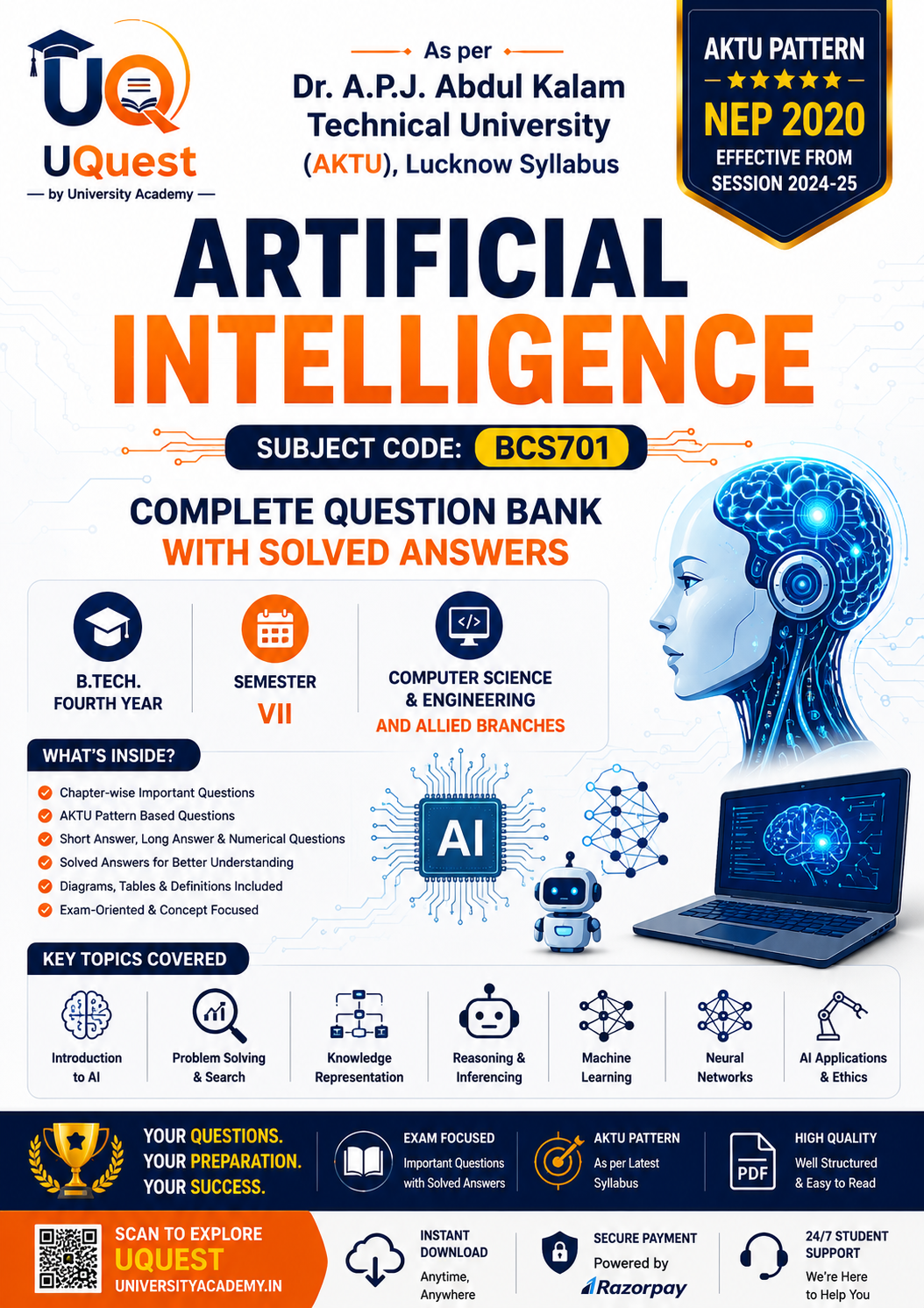
AKTU Artificial Intelligence (BCS701) Question Bank with Solutions – B.Tech 4th Year Sem 7
BCS701
by University Academy
- English
- Semester 7
- 1 downloads
- 90 views
This question bank has been compiled by UQuest (by University Academy) to help you prepare efficiently for the BCS701 Artificial Intelligence semester examination (AKTU). Each of the five syllabus units contains 15 short-answer questions (2 marks) and 15 long-answer questions (7–10 marks), each with a complete, exam-ready solved answer including real, verified worked examples (BFS/DFS/A* search traces, Minimax and Alpha-Beta pruning, Hill Climbing landscapes, CSP backtracking, propositional-logic resolution proofs, forward/backward chaining, Bayes' Rule and Bayesian-network inference, and a full Perceptron training trace), and concept diagrams (agent architectures, search graphs, the Wumpus World, Bayesian networks, NLP pipeline, multi-agent systems) wherever applicable.
Understanding the Tags
- MOST IMPORTANT — Repeatedly asked across multiple AKTU examination years, or covers a core syllabus concept almost certain to be examined — prioritise these first.
- IMPORTANT — Asked in at least one recent AKTU examination, or a high-value supporting concept — cover these after the Most Important questions.
PYQ: AKTU <year(s)> — Indicates this question (or a very close variant of it) has actually appeared in an AKTU Artificial Intelligence examination under BCS701 or a predecessor code (ECS801/NCS702/KCS071) in the year(s) shown, compiled from official/publicly archived AKTU question papers.
A Note on Previous-Year Questions
Artificial Intelligence as a dedicated 7th-semester subject (BCS701) is new to AKTU's curriculum (effective session 2025-26), so no BCS701-coded paper has been held/archived yet at the time of writing. To give you genuinely real exam questions rather than invented ones, this book's PYQ tags are drawn from verified, publicly archived AKTU papers for this subject under its earlier codes — ECS801 (session 2015-16), NCS702 (session 2018-19), and KCS071 (session 2023-24) — the three years for which a complete, verbatim dated paper could be independently confirmed. Coverage gaps for 2016-17, 2017-18, 2019-20, 2020-21, 2021-22, 2022-23, 2024-25 and 2025-26 are real and are reported honestly rather than papered over — for these years either no archived paper could be located, or (for 2020/2021-22/2022-23 papers under code RCS702/KCS071) the papers are known to exist but their content could not be extracted from the source. A small number of questions are drawn from a compiled, undated KCS071 question bank and are correctly left untagged (no PYQ year) rather than assigned a guessed year. Every search, game-tree, logic, probability and perceptron numerical in this book was independently computed and verified in Python (not merely narrated) before being written down. Question wording has, in places, been rephrased slightly for clarity and consistency of style — always cross-check against your own institute's latest circulars for any last-minute syllabus changes.
Suggested Preparation Strategy
- Start each unit with all questions marked ★ MOST IMPORTANT — these give the highest return on revision time.
- Work through every search trace, minimax/alpha-beta tree, and probability/perceptron numerical by hand before checking the worked solution — AI numericals are heavily rewarded in AKTU answer sheets when shown step by step.
- Redraw every diagram (agent architecture, search graphs, Wumpus World, Bayesian network, perceptron, NLP pipeline) from memory — diagram-based recall is heavily rewarded in AKTU answer sheets.
- Revise the ☆ IMPORTANT questions next, followed by the remaining questions for full syllabus coverage.
- Use the Detailed Syllabus section to confirm no topic has been missed before the exam.
- Computer Science and Engineering › 4th Year
- Computer Science › 4th Year
- Computer Engineering › 4th Year
- Information Technology › 4th Year
- Computer Science and Information Technology › 4th Year
- Computer Science & Technology › 4th Year
- Computer Science and Design › 4th Year
- Computer Science and Engineering (Hindi) › 4th Year
- Computer Science and Engineering (Artificial Intelligence) › 4th Year
- Computer Science and Engineering (Artificial Intelligence & Machine Learning) › 4th Year
- Artificial Intelligence and Machine Learning › 4th Year
- Artificial Intelligence (AI) and Data Science › 4th Year
- Computer Science and Engineering (Data Science) › 4th Year
- Computer Science & Engineering (Cyber Security) › 4th Year
- Computer Science and Engineering (Internet of Things) › 4th Year
- Cyber Security › 4th Year
- Data Science › 4th Year
- Computer Science and Engineering (WP) › 4th Year
Ratings & Reviews
Decent quality, got the job done for my prep.
Clean handwriting/formatting, easy to read on mobile too.
Clean handwriting/formatting, easy to read on mobile too.
Good notes overall, covers most of the syllabus.
Saved me a lot of time preparing for my exams.
Good notes overall, covers most of the syllabus.
Perfect for last-minute revision before the exam.
Nice notes, helped me understand the tricky topics.
Very detailed explanation of every topic. Worth it.