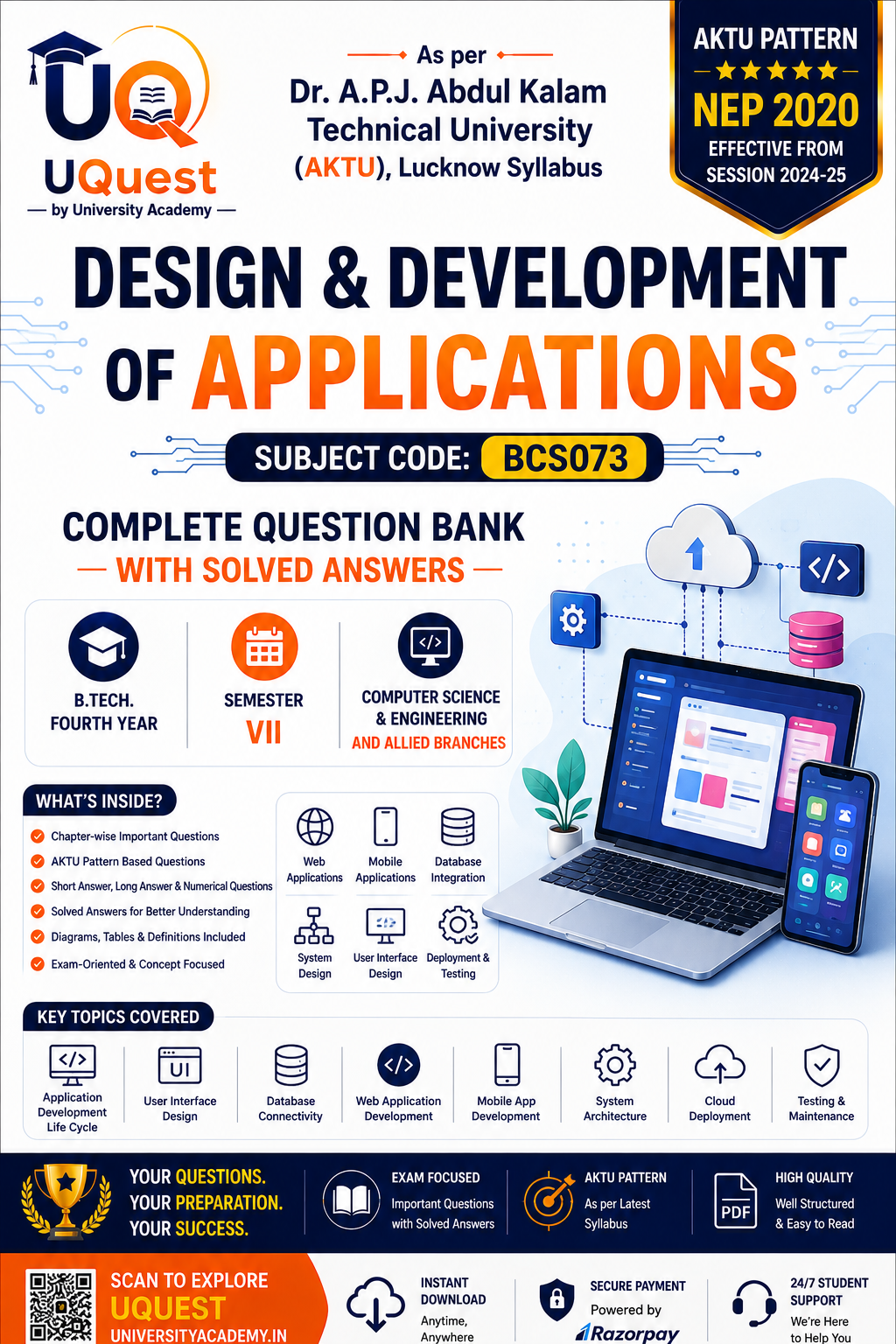
AKTU Design and Development of Applications (BCS073) Question Bank with Solutions – B.Tech 4th Year Sem 7
BCS073
by University Academy
- English
- Semester 7
- 0 downloads
- 16 views
This question bank has been compiled by UQuest (by University Academy) to help you prepare efficiently for the BCS073 Design & Development of Applications semester examination (AKTU). Each of the five syllabus units contains 15 short-answer questions (2 marks) and 15 long-answer questions (7–10 marks), each with a complete, exam-ready solved answer including real, verified worked examples (a Haversine great-circle GPS distance calculation between India Gate and the Taj Mahal, an Android density-independent-pixel to pixel conversion table across all six density buckets, and a verified SQLite CRUD/ORDER BY worked query), idiomatic code samples (Java/Kotlin for Android, Objective-C/Swift for iOS, XML layouts, SQL), and concept diagrams (mobile app ecosystem, embedded system components, app publishing pipeline, layered mobile app architecture, touch gestures, quality attributes, cloud service models, GPS/location flow, MVC pattern, cloud-hosted app access, Android architecture, Activity lifecycle, SQLite flow, iOS architecture, and iOS app states) wherever applicable.
Understanding the Tags
- MOST IMPORTANT — Covers a core syllabus concept almost certain to be examined, or matches the style/topic of the one verified predecessor-code exam paper located for this subject — prioritise these first.
- IMPORTANT — A high-value supporting concept commonly tested in mobile-application-development courses — cover these after the Most Important questions.
PYQ: AKTU <year> (<code>) — Indicates this question (or a very close variant of it) has actually appeared in an AKTU examination for this subject under BCS073 or its direct predecessor code (KCS075) in the year shown, compiled from a publicly archived AKTU question paper.
Suggested Preparation Strategy
- Start each unit with all questions marked ★ MOST IMPORTANT — these give the highest return on revision time.
- Work through the GPS Haversine distance calculation, the Android dp-to-px density table, and the SQLite CRUD example by hand before checking the worked solution — step-by-step working and correctly labelled diagrams are heavily rewarded in AKTU answer sheets.
- Redraw every diagram (mobile app architecture layers, Android architecture, Activity lifecycle, iOS architecture, iOS app states, cloud service models, GPS/location flow) from memory — diagram-based recall is heavily rewarded in AKTU answer sheets.
- Practise writing the Android (Java/Kotlin) and iOS (Objective-C/Swift) code snippets by hand, not just reading them — AKTU frequently asks for code alongside explanation in this subject.
- Revise the ☆ IMPORTANT questions next, followed by the remaining questions for full syllabus coverage.
- Use the Detailed Syllabus section to confirm no topic has been missed before the exam.
- Computer Science and Engineering › 4th Year
- Computer Science › 4th Year
- Computer Engineering › 4th Year
- Information Technology › 4th Year
- Computer Science and Information Technology › 4th Year
- Computer Science & Technology › 4th Year
- Computer Science and Design › 4th Year
- Computer Science and Engineering (Hindi) › 4th Year
- Computer Science and Engineering (Artificial Intelligence) › 4th Year
- Computer Science and Engineering (Artificial Intelligence & Machine Learning) › 4th Year
- Artificial Intelligence and Machine Learning › 4th Year
- Artificial Intelligence (AI) and Data Science › 4th Year
- Computer Science and Engineering (Data Science) › 4th Year
- Computer Science & Engineering (Cyber Security) › 4th Year
- Computer Science and Engineering (Internet of Things) › 4th Year
- Cyber Security › 4th Year
- Data Science › 4th Year
- Computer Science and Engineering (WP) › 4th Year
Ratings & Reviews
Helpful, though a couple of topics could be more detailed.
Exactly what I was looking for — clear and concise.
Really helpful notes, covered everything I needed for the exam.
Clean handwriting/formatting, easy to read on mobile too.
Really helpful notes, covered everything I needed for the exam.
Saved me a lot of time preparing for my exams.