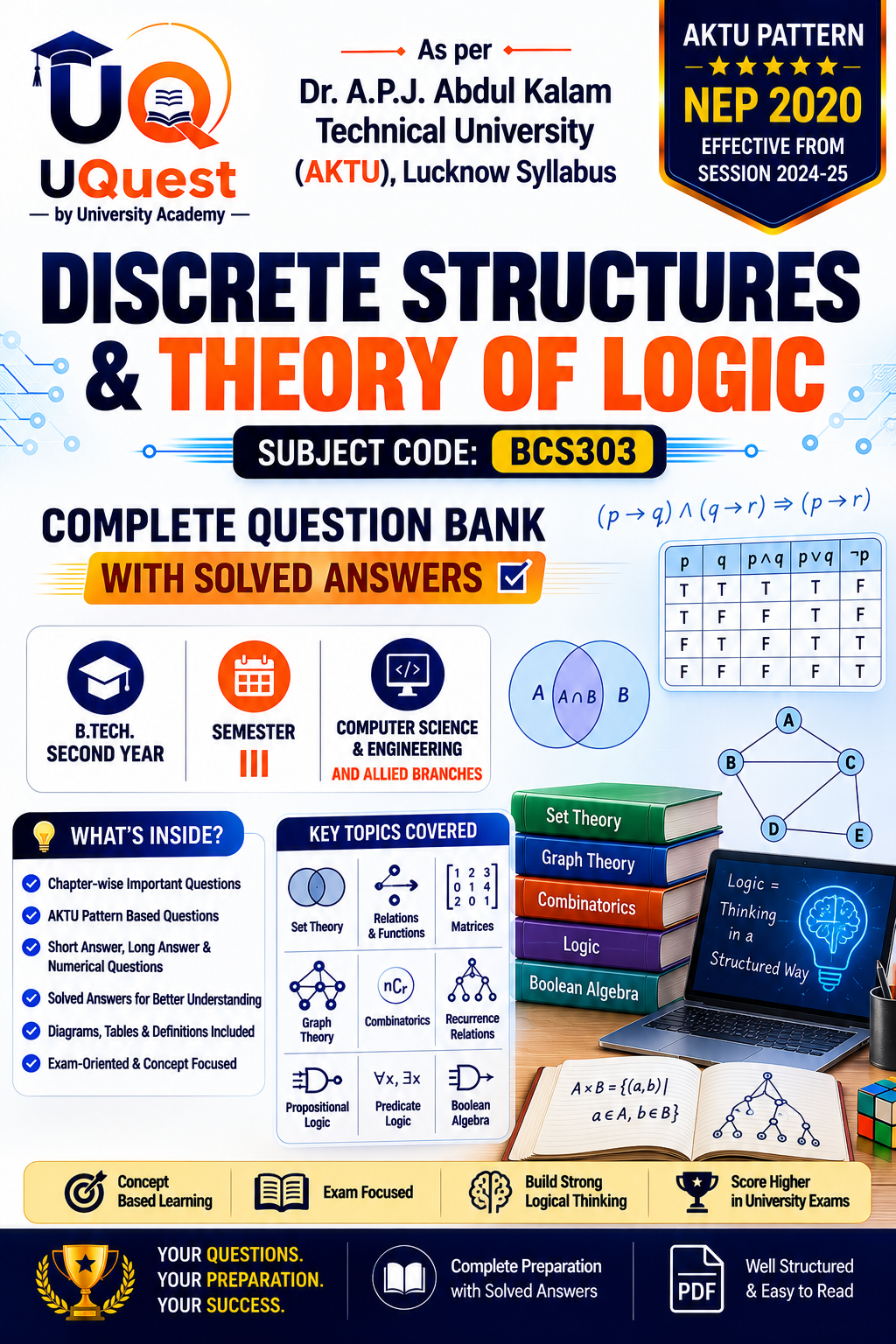
AKTU Discrete Structures and Theory of Logic (BCS303) Question Bank with Solutions – B.Tech 2nd Year Sem 3
BCS303
by University Academy
- English
- Semester 3
- 1 downloads
- 29 views
This question bank has been compiled by UQuest (by University Academy) to help you prepare efficiently for the BCS303 Discrete Structures & Theory of Logic semester examination (AKTU). Each of the five syllabus units contains 15 short-answer questions (2 marks) and 15 long-answer questions (7–10 marks), each with a complete, exam-ready solved answer including Hasse/lattice/graph diagrams, fully worked truth tables and proofs, and solved numericals (K-map simplification, Warshall's algorithm, cosets, Euler's formula, pigeonhole, recurrence relations and more) wherever applicable.
Understanding the Tags
- MOST IMPORTANT — Repeatedly asked across multiple AKTU examination years, or covers a core syllabus concept almost certain to be examined — prioritise these first.
- IMPORTANT — Asked in at least one recent AKTU examination, or a high-value supporting concept — cover these after the Most Important questions.
PYQ: AKTU <year(s)> — Indicates this question (or a very close variant of it) has actually appeared in the AKTU BCS303/KCS303 semester examination in the year(s) shown, compiled from official/publicly archived AKTU question papers spanning 2018–2025.
A Note on Previous-Year Questions
The PYQ year-tags in this book are compiled from publicly archived AKTU Discrete Structures & Theory of Logic (BCS303 / KCS303, formerly RCS301) question papers covering the examinations of 2018-19, 2020-21, 2021-22, 2022-23, 2023-24 and 2024-25 — the most recent genuine AKTU paper for this subject publicly archived at the time of writing. No verified 2025-26 paper was available online at the time of compiling this edition; this book will be updated with 2025-26 PYQ tags as soon as a genuine paper is archived. Where a question in this bank closely matches a previously-asked question, the year(s) it was asked are noted; numerical questions reuse the exact figures from the original paper wherever these could be verified, and are clearly noted as representative worked examples where a specific original data-set could not be confirmed. Question wording has, in places, been rephrased slightly for clarity and consistency of style — always cross-check against your own institute's latest circulars for any last-minute syllabus changes.
Suggested Preparation Strategy
- Start each unit with all questions marked ★ MOST IMPORTANT — these give the highest return on revision time.
- Attempt every numerical / proof question (K-map simplification, Warshall's algorithm, cosets, Euler's formula, pigeonhole principle, recurrence relations) by hand at least once before checking the worked solution.
- Redraw every diagram (Hasse diagrams, lattices, Venn diagrams, K-maps, group/coset diagrams, graph structures) from memory — diagram-based recall is heavily rewarded in AKTU answer sheets.
- Revise the ☆ IMPORTANT questions next, followed by the remaining questions for full syllabus coverage.
- Use the Detailed Syllabus section to confirm no topic has been missed before the exam.
- Computer Science and Engineering › 2nd Year
- Computer Science › 2nd Year
- Computer Engineering › 2nd Year
- Information Technology › 2nd Year
- Computer Science and Information Technology › 2nd Year
- Computer Science & Technology › 2nd Year
- Computer Science and Design › 2nd Year
- Computer Science and Engineering (Hindi) › 2nd Year
- Computer Science and Engineering (Artificial Intelligence) › 2nd Year
- Computer Science and Engineering (Artificial Intelligence & Machine Learning) › 2nd Year
- Artificial Intelligence and Machine Learning › 2nd Year
- Artificial Intelligence (AI) and Data Science › 2nd Year
- Computer Science and Engineering (Data Science) › 2nd Year
- Computer Science & Engineering (Cyber Security) › 2nd Year
- Computer Science and Engineering (Internet of Things) › 2nd Year
- Cyber Security › 2nd Year
- Data Science › 2nd Year
- Computer Science and Engineering (WP) › 2nd Year
Ratings & Reviews
Pretty good, minor formatting issues but content is solid.
Pretty good, minor formatting issues but content is solid.
Perfect for last-minute revision before the exam.
Useful material, would recommend to classmates.
Good notes overall, covers most of the syllabus.
Nice notes, helped me understand the tricky topics.
Exactly what I was looking for — clear and concise.
Well organized and easy to follow. Highly recommend!
Well organized and easy to follow. Highly recommend!