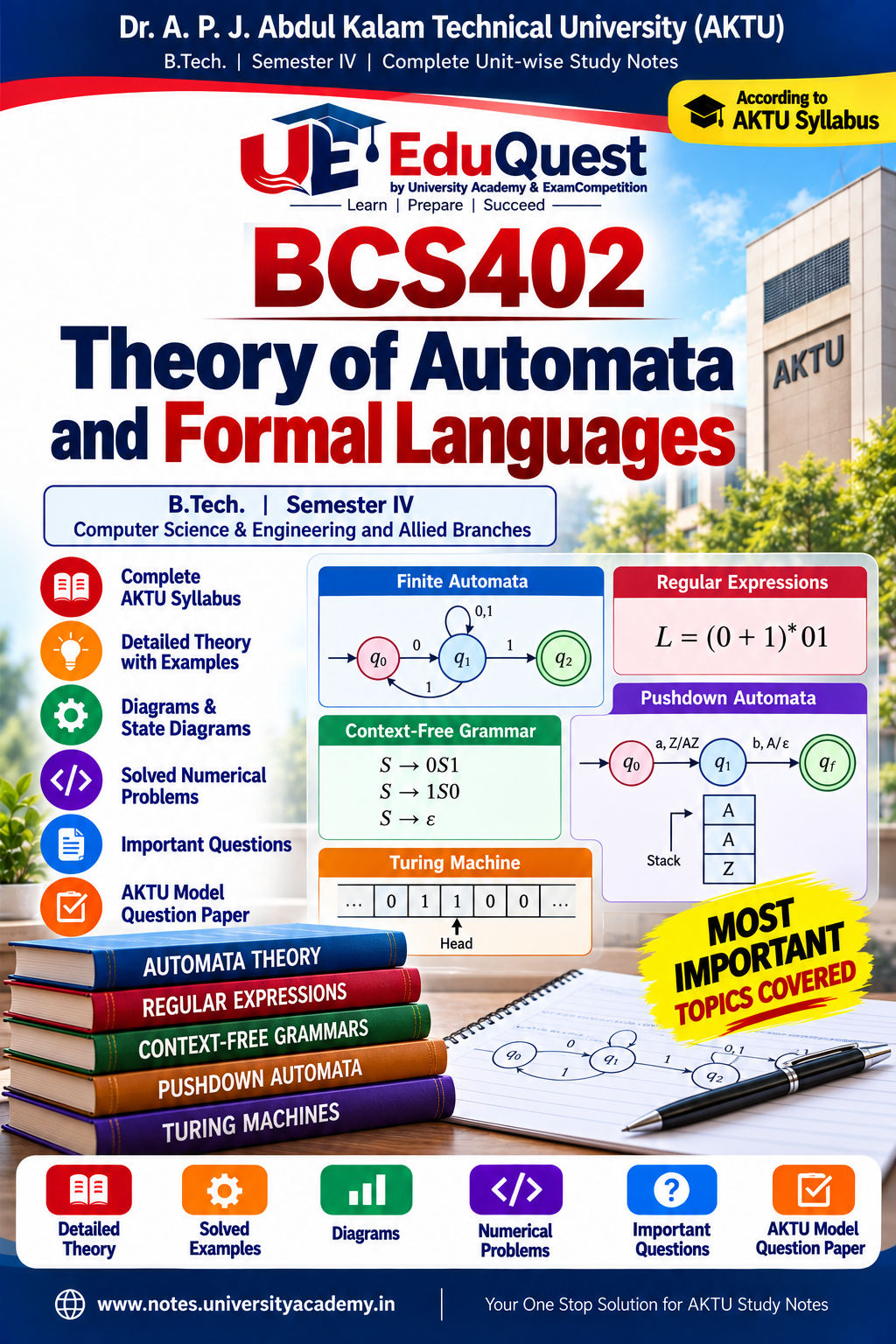
AKTU Theory of Automata and Formal Languages (BCS402) Notes & Study Material PDF – B.Tech 2nd Year Sem 4
BCS402
by EduQuest by University Academy & ExamCompetition
- English
- 151 pages
- Semester 4
- 0 downloads
- 16 views
Complete unit-wise study notes for BCS402 Theory of Automata and Formal Languages for B.Tech. Semester IV students of Computer Science & Engineering and allied branches. These comprehensive notes are designed for conceptual learning, problem solving, revision and university examination preparation.
Subject Details
- Subject Code: BCS402
- Subject: Theory of Automata and Formal Languages
- Programme: B.Tech.
- Semester: IV
- Branch: Computer Science & Engineering and Allied Branches
- Format: Complete PDF Study Notes
- Language: English
- Pages: 151
Complete Unit-Wise Coverage
Unit I - Basic Concepts and Automata Theory
Introduction to Theory of Computation, automata, computability and complexity, alphabet, symbols and strings, formal languages, deterministic finite automata, nondeterministic finite automata, epsilon-NFA, equivalence of DFA and NFA, Moore and Mealy machines and minimisation of finite automata.
Unit II - Regular Expressions and Languages
Regular expressions, algebraic laws, transition graphs, Kleene's theorem, Arden's theorem, state elimination, regular and non-regular languages, closure properties, pigeonhole principle, pumping lemma, applications of pumping lemma, Myhill-Nerode method and decidability properties.
Unit III - Regular and Non-Regular Grammars
Formal grammars, context-free grammars, derivations, sentential forms, parse trees, ambiguity, regular grammars, conversion between finite automata and grammars, Chomsky hierarchy, simplification of CFGs, Chomsky Normal Form, Greibach Normal Form, Backus-Naur Form and CYK algorithm.
Unit IV - Pushdown Automata and Properties of Context-Free Languages
Pushdown automata, formal definition of NPDA, PDA design, deterministic pushdown automata, CFG to PDA and PDA to CFG conversions, two-stack PDA, pumping lemma for context-free languages, closure properties, decision problems and applications of PDA and CFLs.
Unit V - Turing Machines and Recursive Function Theory
Turing machine models, formal definitions, representations, construction techniques, modifications of Turing machines, universal Turing machines, linear bounded automata, Church-Turing thesis, recursive and recursively enumerable languages, halting problem, Post's Correspondence Problem, recursive function theory and computational complexity.
What These Notes Include
- Complete unit-wise Theory of Computation study material
- Detailed theory and definitions
- Theorems and proof ideas
- DFA and NFA construction problems
- State diagrams and automata illustrations
- Solved numerical and construction problems
- Regular expression and grammar problems
- Pushdown automata design problems
- Turing machine construction problems
- Important and most-important topics
- Quick revision material
- Important examination questions
- AKTU-format sample model question paper
Key Topics Covered
- DFA, NFA and epsilon-NFA
- Moore and Mealy Machines
- Finite Automata Minimisation
- Regular Expressions and Arden's Theorem
- Kleene's Theorem
- Pumping Lemma and Myhill-Nerode Theorem
- Context-Free Grammar and Parse Trees
- Chomsky and Greibach Normal Forms
- Pushdown Automata
- Context-Free Languages
- Turing Machines
- Halting Problem and PCP
- Church-Turing Thesis
- Computability and Complexity
Why These Notes Are Useful
These BCS402 notes provide a comprehensive study resource for understanding automata, formal languages, grammars, computability and computational models. The notes combine theory, definitions, algorithms, diagrams, solved examples, numerical problems and examination-oriented questions in one PDF.
Prepared By
EduQuest by University Academy & ExamCompetition
Website: https://www.notes.universityacademy.in/
- Computer Science and Engineering › 2nd Year
- Computer Science › 2nd Year
- Computer Engineering › 2nd Year
- Information Technology › 2nd Year
- Computer Science and Information Technology › 2nd Year
- Computer Science & Technology › 2nd Year
- Computer Science and Design › 2nd Year
- Computer Science and Engineering (Hindi) › 2nd Year
- Computer Science and Engineering (Artificial Intelligence) › 2nd Year
- Computer Science and Engineering (Artificial Intelligence & Machine Learning) › 2nd Year
- Artificial Intelligence and Machine Learning › 2nd Year
- Artificial Intelligence (AI) and Data Science › 2nd Year
- Computer Science and Engineering (Data Science) › 2nd Year
- Computer Science & Engineering (Cyber Security) › 2nd Year
- Computer Science and Engineering (Internet of Things) › 2nd Year
- Cyber Security › 2nd Year
- Data Science › 2nd Year
- Computer Science and Engineering (WP) › 2nd Year
Ratings & Reviews
No reviews yet — share your experience with this item.