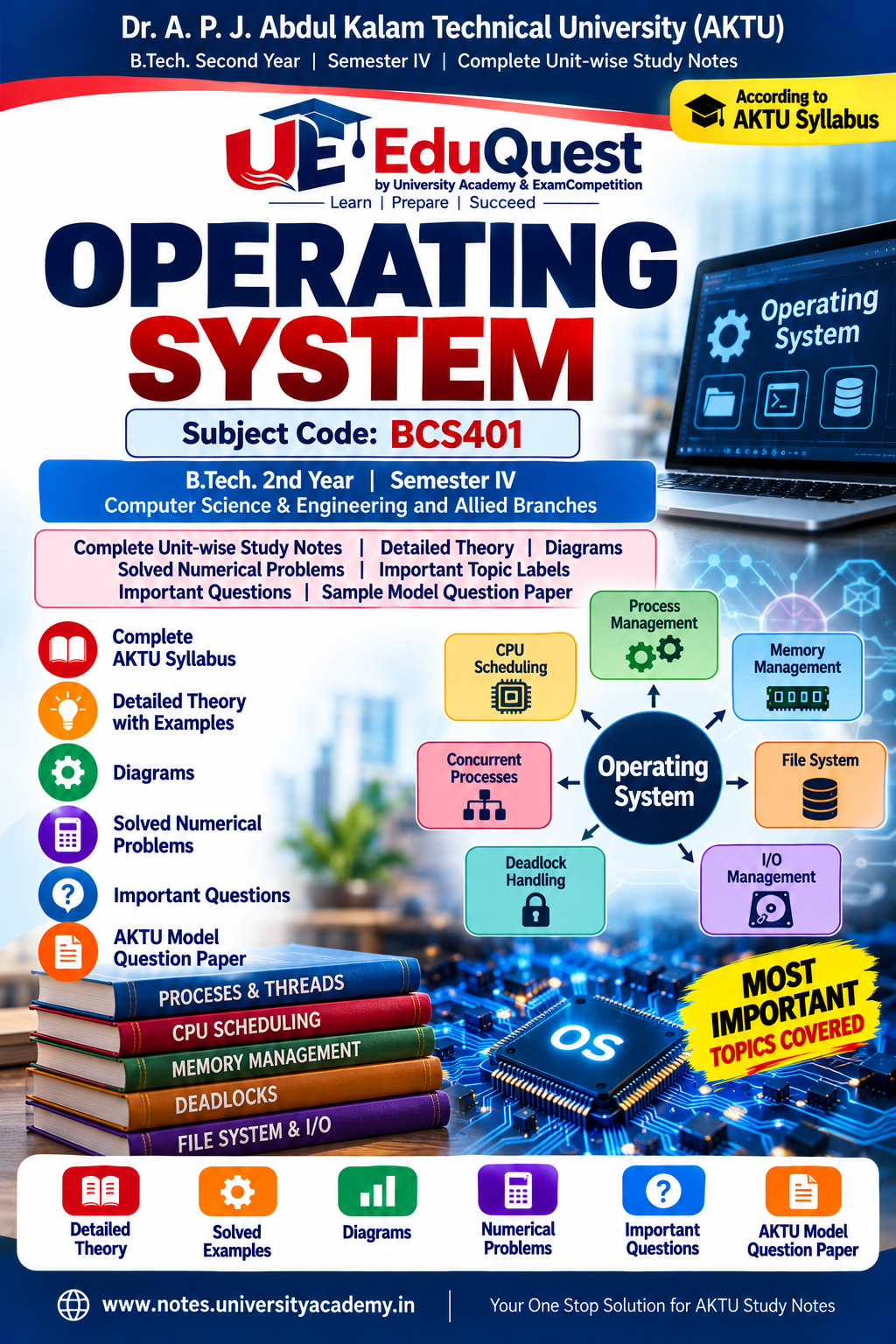
AKTU Operating System (BCS401) Notes & Study Material PDF – B.Tech 2nd Year Sem 4
BCS401
by EduQuest by University Academy & ExamCompetition
- English
- 141 pages
- Semester 4
- 1 downloads
- 20 views
Complete unit-wise study notes for BCS401 Operating System for B.Tech. Second Year, Semester IV students of Computer Science & Engineering and allied branches. These comprehensive notes are designed for conceptual learning, problem solving, revision and university examination preparation.
Subject Details
- Subject Code: BCS401
- Subject: Operating System
- Programme: B.Tech.
- Year: 2nd Year
- Semester: IV
- Branch: Computer Science & Engineering and Allied Branches
- Format: Complete PDF Study Notes
- Language: English
- Pages: 141
Complete Unit-Wise Coverage
Unit I - Introduction to Operating Systems
Operating system definition and goals, functions of operating systems, computer system organisation, classification of operating systems, operating system structures, system components, OS services, booting, shell and kernel interaction, OS evolution, design and implementation, interrupt handling, buffering, caching, spooling and operating system case studies.
Unit II - Concurrent Processes
Process concept, process creation and termination, principles of concurrency, producer-consumer problem, mutual exclusion, critical-section problem, software and hardware solutions, semaphores, classical concurrency problems, monitors, inter-process communication, Lamport Bakery algorithm, spinlocks, busy waiting, memory barriers, POSIX and Java synchronization, sockets and RPC.
Unit III - CPU Scheduling and Deadlock
CPU scheduling concepts, scheduling performance criteria, process states, process transition diagrams, schedulers, Process Control Block, address space, process identification, threads and thread management, scheduling algorithms, multiprocessor scheduling, deadlock system model, deadlock characterization, prevention, avoidance, detection and recovery.
Unit IV - Memory Management
Memory management background, bare machine and resident monitor, contiguous memory allocation, fixed and variable partitions, protection schemes, paging, segmentation, paged segmentation, virtual memory, demand paging, page replacement algorithms, thrashing, cache memory organization and locality of reference.
Unit V - I/O Management and File System
I/O devices and hardware, I/O subsystem and software, I/O buffering, disk storage structure, disk scheduling, RAID, file concepts, file organization and access mechanisms, file directories, file sharing, file system implementation, allocation methods, free-space management, efficiency, performance, recovery, file system protection and security.
What These Notes Include
- Complete unit-wise Operating System study material
- Detailed theory and concept explanations
- Diagrams and system architecture illustrations
- Solved numerical problems
- CPU scheduling and deadlock problems
- Memory management and page replacement problems
- Important and most-important topic labels
- Quick revision points and glossary
- Case studies including UNIX/Linux, Windows and Android architecture
- Frequently asked short notes with model answers
- Important examination questions
- AKTU-format sample model question paper
Why These Notes Are Useful
These BCS401 Operating System notes provide a comprehensive study resource for understanding operating system concepts and preparing for university examinations. The material combines detailed explanations, diagrams, solved numerical problems, important topics, revision points and examination-oriented questions in one PDF.
Key Topics
- Operating System Functions and Structures
- Processes and Threads
- Process Synchronization and Semaphores
- CPU Scheduling Algorithms
- Deadlock Prevention, Avoidance and Detection
- Paging and Segmentation
- Virtual Memory and Page Replacement
- Disk Scheduling and RAID
- File Systems and File Allocation
- File System Protection and Security
Prepared By
EduQuest by University Academy & ExamCompetition
Website: https://www.notes.universityacademy.in/
- Computer Science and Engineering › 2nd Year
- Computer Science › 2nd Year
- Computer Engineering › 2nd Year
- Information Technology › 2nd Year
- Computer Science and Information Technology › 2nd Year
- Computer Science & Technology › 2nd Year
- Computer Science and Design › 2nd Year
- Computer Science and Engineering (Hindi) › 2nd Year
- Computer Science and Engineering (Artificial Intelligence) › 2nd Year
- Computer Science and Engineering (Artificial Intelligence & Machine Learning) › 2nd Year
- Artificial Intelligence and Machine Learning › 2nd Year
- Artificial Intelligence (AI) and Data Science › 2nd Year
- Computer Science and Engineering (Data Science) › 2nd Year
- Computer Science & Engineering (Cyber Security) › 2nd Year
- Computer Science and Engineering (Internet of Things) › 2nd Year
- Cyber Security › 2nd Year
- Data Science › 2nd Year
- Computer Science and Engineering (WP) › 2nd Year