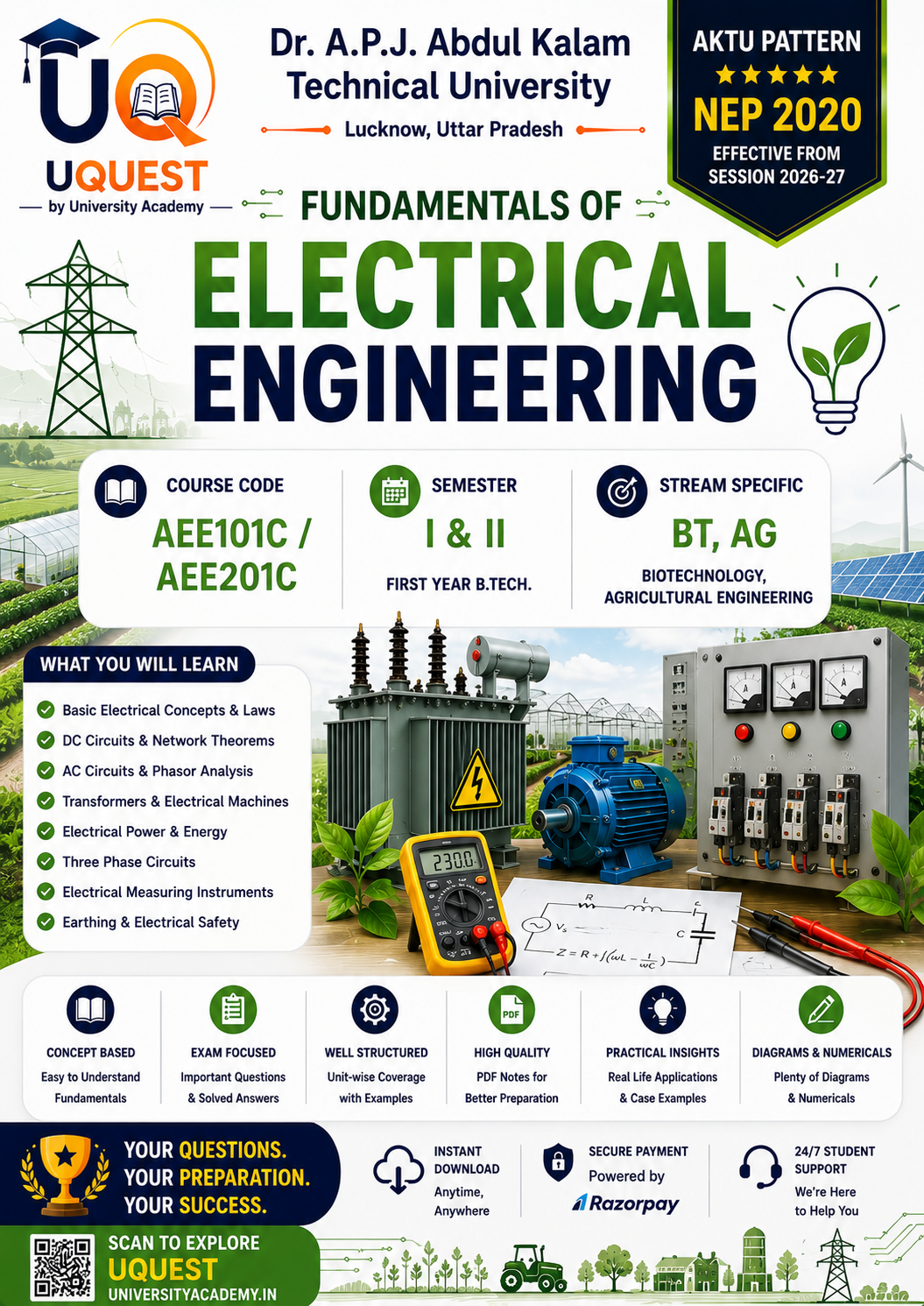
AKTU Fundamentals of Electrical Engineering (AEE101C/AEE201C) Question Bank with Solutions – B.Tech 1st Year
AEE101C/AEE201C
by University Academy
- English
- 0 downloads
- 11 views
This UQuest question bank has been prepared strictly as per the AKTU (Dr. APJ Abdul Kalam Technical University, Lucknow) First Year B.Tech syllabus for the course AEE101C / AEE201C — Fundamentals of Electrical Engineering, an Engineering Science Course (ESC) applicable to the BT (Biotechnology) and AG (Agricultural Engineering) streams across Semester I and II. This is a basic electrical engineering course framed around agricultural and biomedical equipment and instrumentation — every unit connects core electrical theory to the kind of devices these students will encounter in the field and the laboratory, from irrigation pump motors and soil-moisture sensors to biomedical monitoring instruments and greenhouse control systems. It builds the ability to analyse DC circuits using Ohm's law and Kirchhoff's laws, solve single-phase AC circuits and understand power requirements of agri and biomedical equipment, understand electrical measurements and the working of common measuring instruments, explain the fundamental concepts of transformers and electrical machines, and understand electrical safety, earthing, sensors and transducers as they relate to emerging agricultural and biomedical applications. Every unit below is covered with three categories of practice questions, each with complete, concise, exam-ready solutions — including worked numerical problems on DC network analysis, AC power calculations, instrument calibration, and transformer ratios/efficiency where the syllabus calls for analysis — to help students revise concepts and prepare thoroughly for the semester end examination.
Question Pattern Followed Per Unit
- Section A: 15 Multiple Choice / True-False Questions — with correct answer and explanation.
- Section B: 12 Short Answer Type Questions — with concise, exam-ready answers.
- Section C: 12 Long Answer Type Questions — with structured explanations, illustrative examples, and diagrams.
- ★ Most Important and ★ Important tags mark questions with the highest probability of appearing in the AKTU semester examination, based on topic weightage and repetition trends — prioritize these while revising.
This subject builds a working, agriculture-and-biomedical-applications-first understanding of basic electrical engineering across five units of equal weightage: basic electrical quantities and DC circuits (20% — charge, current, voltage, resistance, power and energy, Ohm's law, series/parallel resistors, voltage divider, KVL, KCL, and simple mesh and nodal analysis), AC circuits and power (20% — peak/RMS/average values, phasor representation, R/L/C series and parallel circuits, impedance and admittance, active/reactive/apparent power, power factor and its significance, and single-phase power measurement using a wattmeter), electrical measurements (20% — basic working principle and types of measuring instruments, accuracy/precision/resolution/sensitivity, gross/systematic/random errors, DC and AC measurement, and the construction and principle of PMMC, Moving Iron, dynamometer, and induction-type instruments), transformers and electrical machines (20% — single-phase transformer working principle, EMF equation, turns ratio, efficiency and losses, step-up/step-down transformers, DC motor types/principle/torque/basic speed control, and three-phase induction motor rotating magnetic field, slip and torque-speed characteristics), and electrical safety and emerging applications (20% — electrical hazards of shock and fire, earthing and grounding, working principle of fuses, sensors and transducers, laboratory electrical safety, and applications such as fluorescent lamps, water-pump and irrigation-pump motors, key components of an electricity bill, and sensors/transducers used in biomedical and agricultural equipment). Fifteen labelled diagrams illustrate key circuits, instruments and concepts across all five units — from Ohm's-law dividers and KVL/KCL mesh-nodal analysis to PMMC/Moving-Iron and dynamometer/induction-meter construction, transformer and motor operation, and fuse/sensor working. Two full-length Model Question Papers are included at the end of this book, formatted exactly in the official AKTU BTECH theory-examination pattern (Section A / B / C, CO and Level columns, 3 Hours, 70 Marks), so students can attempt a complete, timed mock test as final practice. See the Index above for page references.
Ratings & Reviews
Good notes overall, covers most of the syllabus.
Good notes overall, covers most of the syllabus.
Very detailed explanation of every topic. Worth it.
Nice notes, helped me understand the tricky topics.
Useful material, would recommend to classmates.