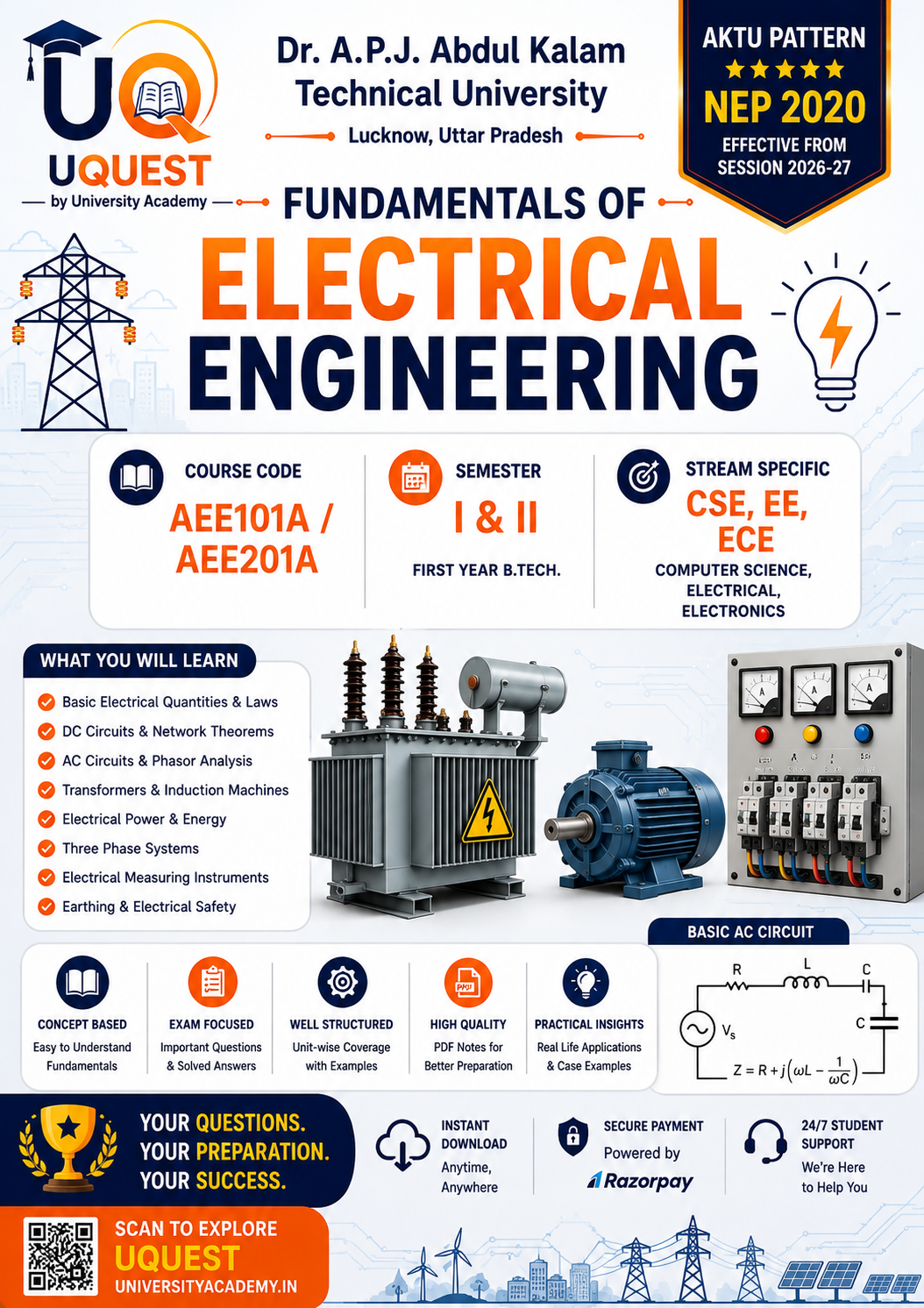
AKTU Fundamentals of Electrical Engineering (AEE101A/AEE201A) Question Bank with Solutions – B.Tech 1st Year
AEE101A/AEE201A
by University Academy
- English
- 1 downloads
- 48 views
This UQuest question bank has been prepared strictly as per the AKTU (Dr. APJ Abdul Kalam Technical University, Lucknow) First Year B.Tech syllabus for the course AEE101A / AEE201A — Fundamentals of Electrical Engineering, an Engineering Science Course (ESC) applicable to the CSE, EE and ECE streams across Semester I and II. This is a Basic Electrical Engineering course — no electronics device theory is included — and it builds the ability to analyse DC and AC circuits, understand three-phase power systems, work with transformers, and relate electrical machines and emerging systems (solar PV, EVs) to devices used every day, such as phone chargers, laptops, fans, UPS units, and electric vehicles. Every unit below is covered with three categories of practice questions, each with complete, concise, exam-ready solutions — including worked numerical problems on circuit analysis, power calculations, transformer ratios/efficiency, and machine performance where the syllabus calls for analysis — to help students revise concepts and prepare thoroughly for the semester end examination.
Question Pattern Followed Per Unit
- Section A: 15 Multiple Choice / True-False Questions — with correct answer and explanation.
- Section B: 12 Short Answer Type Questions — with concise, exam-ready answers.
- Section C: 12 Long Answer Type Questions — with structured explanations, illustrative examples, and diagrams.
- ★ Most Important and ★ Important tags mark questions with the highest probability of appearing in the AKTU semester examination, based on topic weightage and repetition trends — prioritize these while revising.
This subject builds a working, applications-first understanding of basic electrical engineering across five units: basic electrical quantities and DC circuits (charge, current, voltage, EMF, resistance, Ohm's law, series/parallel resistors, voltage and current dividers, power and energy, KVL, KCL, mesh and nodal analysis, and Thevenin's theorem), AC circuits (sinusoidal waveforms — peak, RMS, average, form factor — phasor representation, pure R/L/C behaviour, series RL and RC circuits, impedance, active/reactive/apparent power, power factor and its improvement using capacitors, and single-phase power measurement using a wattmeter), three-phase systems (advantages over single-phase supply, balanced three-phase generation, star and delta connections, phase and line quantities, power in balanced three-phase circuits, the two-wattmeter method, and the concept of the neutral wire), magnetic circuits and transformers (flux, MMF, reluctance, Faraday's law, self- and mutual inductance, transformer construction and EMF equation, ideal-transformer ratios, the basic equivalent circuit, losses, and efficiency), and electrical machines and emerging electrical systems (DC motor principle, back EMF, torque and speed control, types of DC motors, the BLDC motor, three-phase induction motor rotating field/slip/torque, and an introduction to solar photovoltaic systems and electrical safety in the laboratory). Fifteen labelled diagrams (three per unit) illustrate key circuits and concepts such as Ohm's-law dividers, KVL/KCL mesh-nodal analysis, Thevenin's theorem, AC waveforms and phasors, impedance triangles, the power triangle and wattmeter connection, three-phase phasors, star/delta connections, the two-wattmeter method, magnetic-circuit/inductance analogy, transformer construction and turns ratio, transformer equivalent circuit and efficiency, DC-motor principle and back EMF, induction-motor/BLDC operation, and the solar-PV/electrical-safety summary. Two full-length Model Question Papers are included at the end of this book, formatted exactly in the official AKTU BTECH theory-examination pattern (Section A / B / C, CO and Level columns, 3 Hours, 70 Marks), so students can attempt a complete, timed mock test as final practice. See the Index above for page references.
- Electrical Engineering › 1st Year
- Electrical & Electronics Engineering › 1st Year
- Electrical & Computer Engineering › 1st Year
- Electrical Engineering (WP) › 1st Year
- Electronics Engineering › 1st Year
- Electronics and Communication Engineering › 1st Year
- Electronics and Communication (Advanced Communication Technology) › 1st Year
- Electronics Engineering (VLSI Design and Technology) › 1st Year
- Electronics and Instrumentation Engineering › 1st Year
- Instrumentation and Control Engineering › 1st Year
- Electronic and Computer Engineering › 1st Year
- Computer Science and Engineering › 1st Year
- Computer Science › 1st Year
- Computer Engineering › 1st Year
- Information Technology › 1st Year
- Computer Science and Information Technology › 1st Year
- Computer Science & Technology › 1st Year
- Computer Science and Design › 1st Year
- Computer Science and Engineering (Hindi) › 1st Year
- Computer Science and Engineering (Artificial Intelligence) › 1st Year
- Computer Science and Engineering (Artificial Intelligence & Machine Learning) › 1st Year
- Artificial Intelligence and Machine Learning › 1st Year
- Artificial Intelligence (AI) and Data Science › 1st Year
- Computer Science and Engineering (Data Science) › 1st Year
- Computer Science & Engineering (Cyber Security) › 1st Year
- Computer Science and Engineering (Internet of Things) › 1st Year
- Cyber Security › 1st Year
- Data Science › 1st Year
- Computer Science and Engineering (WP) › 1st Year
Ratings & Reviews
Pretty good, minor formatting issues but content is solid.
Saved me a lot of time preparing for my exams.
Perfect for last-minute revision before the exam.
Useful material, would recommend to classmates.
Useful material, would recommend to classmates.
Perfect for last-minute revision before the exam.
Nice notes, helped me understand the tricky topics.